

Rhubarb

Rhubarb is a hardy, long-lived perennial vegetable that is grown for its thick, colourful leaf stalks, which are used in a wide range of sweet and savoury dishes. Once established, a rhubarb plant can crop reliably for many years, making it an excellent investment for the kitchen garden.
In Ireland, rhubarb is most commonly grown from crowns, which are widely available in garden centres and establish much faster than seed-grown plants. While rhubarb can be grown from seed, this is a slower process and plants may vary in vigour and colour.
Rhubarb is also one of the few crops that can be harvested very early in the year by a process known as forcing, which produces tender, pale pink stems when little else is available from the garden.
How to grow Rhubarb
- Soil and Site – Rhubarb prefers a fertile, moisture-retentive but free-draining soil in an open, sunny or lightly shaded position. As a long-term crop, it is worth preparing the ground thoroughly before planting by incorporating plenty of well-rotted manure or compost. Avoid waterlogged sites, as crowns can rot in winter.
- Planting – From Crowns – Rhubarb crowns are usually planted from late autumn through to early spring, while the plant is dormant. Set crowns so the growing point sits just at or slightly below soil level. Space plants generously, allowing around 90cm between crowns, as mature plants become quite large.
- Sowing – From Seed – Rhubarb can be grown from seed, sown indoors from March onwards. Seed-grown plants take longer to establish and should not be harvested in their first year. Because seedlings can vary, crowns are generally preferred for reliability and earlier cropping.
Cultivation & Care
- Watering – Keep plants well watered during dry spells, particularly in their first year and during active growth in spring and summer. Mulching around the plant helps retain moisture and suppress weeds.
- Feed – Apply a generous mulch of well-rotted manure or compost each winter. In spring, an additional general-purpose fertiliser can help support strong growth.
- Weed Control – Keep the area around plants free of weeds, particularly while plants are becoming established. Take care not to damage shallow roots when weeding.
- General Care – Do not harvest stalks in the first year after planting to allow the plant to establish fully. Remove flower stems promptly if they appear, as flowering reduces vigour.
Forcing Rhubarb
Forcing rhubarb encourages early growth by excluding light, producing tender, pale stems that are less acidic than outdoor-grown rhubarb. In Ireland, forcing is typically done from January to February.
- Only force established plants that are at least 2 years old.
- Cover the crown with a rhubarb forcer, an upturned bin, bucket or large pot that blocks out light completely.
- Insulate around the forcer with straw, compost or fleece to help retain warmth.
- Check regularly and harvest stems once they reach 30–40cm in length, usually after 4–6 weeks.
Forcing is stressful for the plant and should not be done every year on the same crown. If you have multiple rhubarb plants, it is best to rotate forcing between them from year to year, allowing each crown time to recover.

"Being a fan of Rhubarb I grow three crowns in a bed which allows me to cover one with a large upturned black pot for forcing early in the year (January/February). You'll noticed I also covered the pot I used with a black bag just to make sure no light was getting through any drainage holes. In about 6-8 weeks I'll check the stems and once they are about 30cm long, they should be good for harvesting. I'll then let that crown grow on as normal and next year I'll choose another crown to force so that each crown gets 2 years 'rest' before forcing again. As you can also see, I've a bit of work ahead of me to remove the weeds and grass from my pathways..." - Richard - Photo taken 16 January 2026 in Boyle.
Harvest and Storage
Rhubarb is ready to harvest from spring through to early summer. Pull stalks gently from the base rather than cutting, taking only a few stems at a time to avoid weakening the plant. Stop harvesting by early summer to allow the plant to rebuild its energy reserves.
Rhubarb stalks can be stored in the fridge for short periods, frozen raw or cooked, or preserved as compotes and jams.
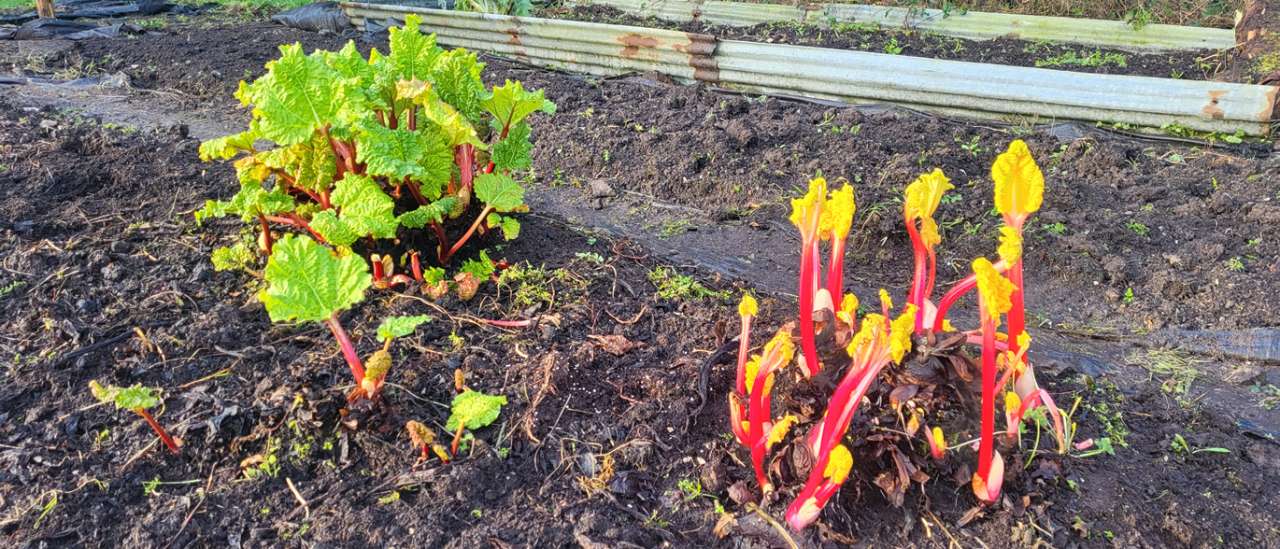
"After just 6 weeks of covering a crown of rhubarb you can see the forced/covered crown on the right hand side has developed bright pink tender shoots that are now ready for harvesting and should be sweeter than those on the exposed plant on the left. Once harvested I'll then allow the plant to continue growing without a cover for the rest of the season" - Photo taken on 2nd March 2026 in Boyle - Richard.
Culinary Use
Rhubarb is most commonly used in desserts such as crumbles, tarts and pies, but it can also be used in savoury dishes, chutneys and sauces. Its sharp flavour pairs particularly well with sugar, ginger, orange and strawberries.
Recipe – Rhubarb & Mackerel
Whilst we commonly associate rhubarb with desserts, it has long been used in a variety of fish dishes. In this particular dish, adapted from 'Nigel Slater's Simple Suppers', the tartness of the rhubarb cuts through the oiliness of the mackerel, resulting in a nice balanced lunch or supper.
Ingredients
For the roasted rhubarb
4-5 stalks rhubarb
good shake of light brown sugar
For the mackerel
2 fresh mackerel, filleted
a little plain flour, seasoned with salt and freshly ground black pepper, for dusting
2tbsp of extra virgin olive oil
a few sprigs of rosemary chopped or some fresh thyme
1 tbsp capers (optional)
splash sherry vinegar
Method
-
Preheat the oven to 200C (or 180C fan). Cut the rhubarb into 15cm/6in or so lengths and place in a roasting tin with 100ml of water and the light brown sugar. Roast until just soft enough to take the point of a knife, about 10-15 minutes. Allow to cool, then drain, reserving the cooking juices.
-
Dip the skin side of each mackerel fillet into the seasoned flour to lightly coat. Heat the oil in a large frying pan. Gently place the mackerel fillets in the hot pan, skin-side down, and scatter over the rosemary or thyme leaves. Add the roasted rhubarb to the side of the pan to heat through and add the capers (optional)
-
Turn the mackerel after just two or so minutes when you can see that the mackerel is cooked halfway up the fillet. Cook for a further minute or two, then add the sherry vinegar for richness and allow to just come to the boil in the pan before removing the mackerel and the rhubarb. To the pan juices, add a little of the juices from the reserved roasted rhubarb to just lift the crispy bits from the pan where all the flavour is. Serve straightaway, with the sauce over the mackerel and the rhubarb on the side.
Alternative Variation - For a more Asian inspired variation on this dish, scatter the mackerel with ginger, some dry chili flakes and garlic and instead of adding the capers, sherry wine and rhubarb juices, add about a tablespoon of Soy Sauce, then serve with with the rhubarb on the side along with some steamed Pak Choi and maybe a little boiled rice for a more substantial meal.
Nutritional Information
According to Bord Bia, the Irish Food Board:
Per 100g serving
- Calories – 48 kcal
- Protein – 0.9g
- Carbohydrate – 4.5g
- Fat – 0.1g
- Fibre – 1.2g
Rhubarb is low in calories, provides fibre and is an excellent source of vitamin K (which encourages bones to lay down calcium and is essential in making the proteins necessary for blood clotting, allowing wounds to heal).
NOTE - Only the stalks should be eaten, as the leaves are toxic.