

Potatoes

Potatoes are one of the most reliable and productive crops for the Irish garden and remain a staple in the kitchen. Growing your own potatoes allows you to enjoy a wider range of varieties, better flavour and the satisfaction of harvesting a substantial crop from relatively little effort.
Potatoes are grown from specially produced seed potatoes rather than true seed, and these are grouped into three main types: first earlies, second earlies and maincrop. Each group differs in planting time, harvest period and storage potential.
Before planting, seed potatoes are often chitted to encourage strong early growth, particularly with first early varieties.
How to grow Potatoes
- Soil and Site – Potatoes grow best in an open, sunny position with free-draining soil. Avoid growing potatoes on freshly manured ground as this can encourage scab, instead try to incorporate well-rotted organic matter the previous autumn or winter. If you do have to add organic matter later, try to do this at least a month (preferably 6 weeks) ahead of planting. Incorporating too much nitrogen-rich manure can cause the potatoes to put most of their energy into creating lush foliage which can lower yields and make them susceptible to blight later in the season. Alternatively, you can apply a 10cm layer of garden compost or well-rotted manure after planting the potatoes – ideal for a no-dig veg plot.
Potatoes fit well into crop rotation and are often used to help clear and prepare new ground or to follow the previous years bed of onions & root vegetables (carrots and parsnips). - Chitting – Chitting involves allowing seed potatoes to sprout before planting. Place seed potatoes in trays or egg boxes with the rose (the end with the most eyes) facing upwards, and keep them in a cool, bright, frost-free place. Chitting usually begins in late January or February and is most beneficial for first early and second early potatoes.
- Planting – Planting times vary depending on potato type:
- First Earlies – For those growing an early crop in a tunnel or greenhouse, chitted early potatoes can be planted as early as late January up until March. For outdoor sowings, these usually take place from mid to late March once the soil is workable. Traditionally potatoes are planted in Ireland on St. Patrick's Day (or even on Good Friday depending on the day it fell) as some believed the crop would be blessed.
- Second Earlies – Early April.
- Maincrop – Mid to late April.
- Spacing – Plant seed potatoes 10–15cm deep. Space first and second earlies about 25cm apart with 50cm between rows. Maincrop varieties need more space, at around 35cm between plants and 75cm between rows.
- Growing potatoes in containers - if you don't have the ground space, you can grow potatoes in large containers - buckets, pots, old compost sacks or specialist potato sacks can all be used as long as there is adequate drainage. Aim for a container that is at least 45cm deep and 30cm wide. Add 15cm of multipurpose compost and add one seed potato per 30cm of container diameter, covering with a further 15cm of compost. This will the give you a further 15cm head room to earth up your potatoes as they emerge later in the season which will protect shoots from frost and should increase your yield.
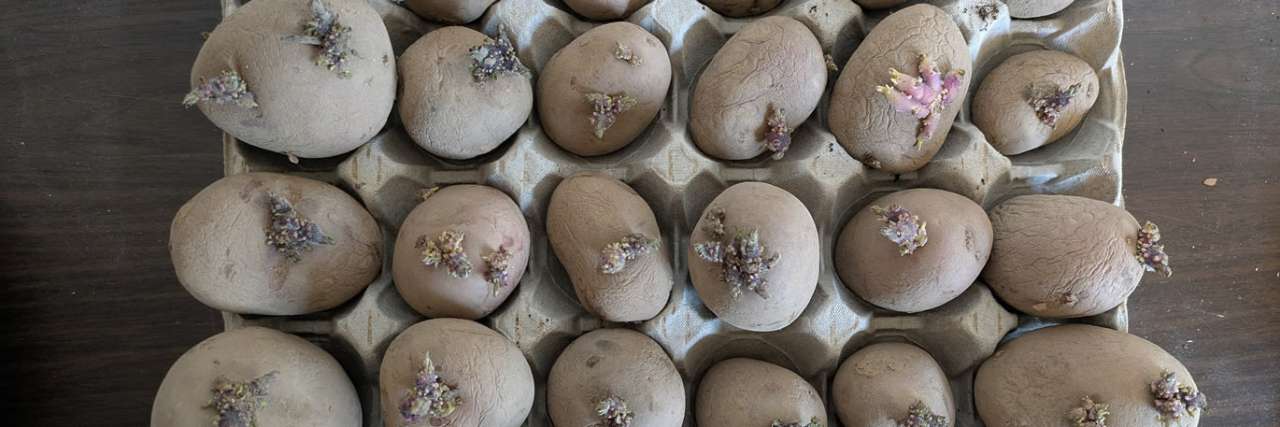
"Chitting potatoes in cardboard egg boxes is said to artificially elongate the growing season. That said, there is conflicting scientific evidence on this as from the limited studies carried out it appears that this depends more on the variety of potato than being something that is a 'fact' across all potatoes. Personally I have planted chitted and non chitted potatoes and haven't seen a noticable different in yields but maybe that's just the varieties I've been growing. I suppose if there is a chance of increased yields and you have the free window space, it's a simple practice to carry out. You might also try planting a few chitted and non-chitted seed potatoes as a personal study to see what works for you!" - Richard. Photo by by Kangarooth (CC BY-SA 4.0).
Cultivation & Care
- Earthing Up – As young shoots emerge, gradually draw soil up around the stems (to form ridges if growing in rows). This protects young shoots from frost. When your shoots are around 20cm high, earth up again so that only 10cm of the shoot remains visible. Earthing up will prevent your developing tubers from becoming exposed to sunlight and turning green and inedible - this may also offer more protection for your tubers from blight, should it contaminate your plants later in the season (see below). In the case of first earlies, there may be no need to continually earth-up through the season as long as you have protected those initial shoots from late frost and have enough soil or mulch on the surface to prevent tubers being exposed. For most maincrop varieties, and one or two second-early varieties ('Nicola' being the one that comes to mind), more regular earthing up can increase yields as these plants produce potatoes across multiple layers (as opposed to across a single layer as early varieties do.)
- Watering – Potatoes generally require little watering early on, but consistent moisture is important once tubers begin to form, particularly during dry spells.
- Feed – Potatoes do not usually need additional feeding if grown in reasonably fertile soil. Excess nitrogen can encourage leaf growth at the expense of tuber formation.
- Pest & Disease Control – Slugs can damage tubers, particularly in wet conditions. Blight ( Phytophthora infestans) is the most serious disease affecting potatoes, especially maincrop varieties. Good spacing, airflow and choosing blight-resistant varieties like 'Sarpo Mira', 'Sarpo Una', 'Cara' and 'Valor' can greatly help reduce risk. Insuring a good nutrient balance in the soil will also be of benefit as applying too much nitrogen rich fertiliser can cause too lush a foliage growth which can make the leaves more susceptible.
This is a common problem in Ireland due to our humidity, especially late in the season. If you are unfortunate enough to have blight affect your crop, catching it early can save your crop. Blight can be identified by a rapidly spreading, watery rot of the leaves, which soon collapse, shrivel and turn brown. You may also see brown lesions on the stems. If you identify it early enough and it is only affecting the top of the plant, you can remove the plant tops before the tubers get infected. When infection levels reach to cover about 25% of the plant or lesions appear on stems cut off the foliage at soil level and rake up any debris. You should leave the tubers in the ground for about two weeks for the skins to harden and then the tubers can be dug up.
Any infected foliage removed should be burnt or added to green waste collection (brown bin) and should NOT be added into your own compost as this will only infect it and cause the fungus to spread the following season.

Potato blight and how it presents on the plant (left) and, if your unlucky enough for it to reach into the soil, on the tuber itself (right) - Images by Rasbak (CC BY-SA 3.0) and I.Sáček, senior (CC0 1.0) respectively.
Harvest and Storage
Harvest times depend on potato type:
- First Earlies – Ready from late May to June, usually harvested as new potatoes. These are best eaten fresh and do not store well.
- Second Earlies – Harvested from July to August. These can be eaten fresh or stored for short periods.
- Maincrop – Harvested from late August to October once foliage has died back. These are suitable for long-term storage.
For storage, lift potatoes in dry weather and allow them to dry on the surface of the soil for a few hours before moving to a cool, dark, frost-free place. Only undamaged tubers should be stored.
Culinary Use
Potatoes are incredibly versatile and can be boiled, roasted, mashed, baked or fried. Different varieties are suited to different uses, from waxy potatoes ideal for salads to floury types perfect for roasting and mashing.
Recipe – Dauphinoise potatoes
This recipe is adapted from a classic BBC Good Food method and is ideal for showcasing home-grown potatoes.
Ingredients
1kg floury potatoes (like King Edward or Desiree) sliced to about 3mm thick. Slice in a food processor if you have it, to save time
3-4 garlic cloves, grated
500ml double cream
Salt & pepper to taste
Method
- Preheat the oven to 160°C (140°C fan).
- Place the potato slices and grated garlic in a bowl, season with salt & pepper to taste, pour over the cream and mix well.
- Pour into a large gratin dish and level the potato slices, pressing down to form a solid layer. The cream should come to just below the top layer of potato so top up with more double cream if necessary.
- Bake for 1–1½ hours, or until the potatoes are completely tender.
Nutritional Information
According to Bord Bia, the Irish Food Board:
Per 100g serving
- Calories – 74 kcal
- Protein – 1.8g
- Carbohydrate – 17.5g
- Fat – 0.1g
- Fibre – 1g (NSP) 1.6g (AOAC)
Potatoes are a good source of vitamin C, vitamin B6 and potassium (which contributes to maintenance of normal blood pressure) and are naturally low in fat.