

Cauliflower
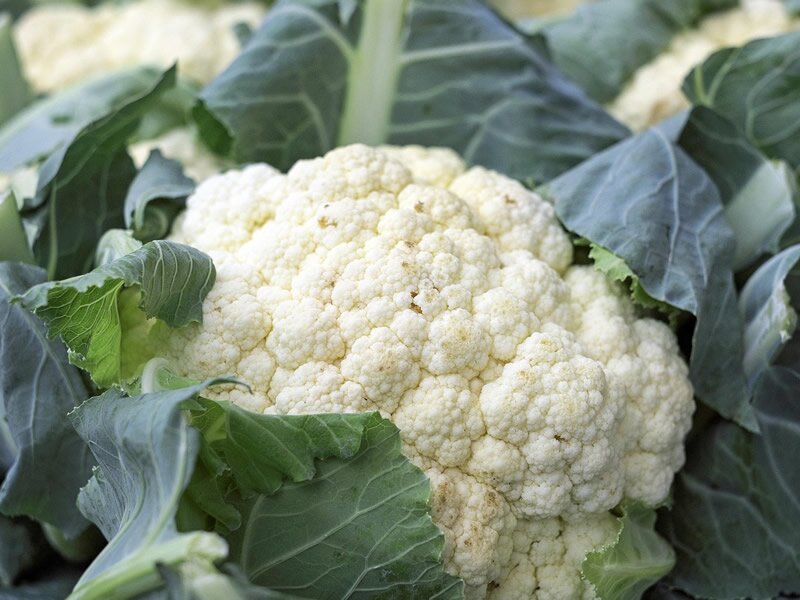
Cauliflower is a rewarding but slightly more demanding brassica, producing tight white curds when grown in fertile, moisture-retentive soil. They do also take up a fair bit of space, so this is something to consider when planning your vegetable patch, however, there is no doubting that a home-grown cauliflower, cut fresh from the plot, has a much better flavour than any store bought varieties!
It is worth noting that, as for most brassicas, cauliflower really doesn't like acidic soils, with an ideal pH being somewhere between 6.5 and 7.0 (slightly alkaline to neutral). That said they do love cooler growing conditions and moderate humidity so they are perfect for the Irish climate.
How to grow Cauliflower
- Sowing – Early varieties can be started indoors from February in a heated propagator for summer crops. You can just add a few seeds to a small tray and once they have germinated and are large enough to handle you can prick them out and plant them in modular trays to grow on until you plant them out in March/April. Alternatively you can wait until late March and just sow into modular trays. they will usually germinate in about a week and can be planted out about 4-5 weeks later. This is one of those plants that benefits from successional sowing so as to not have a load of curds all at once, so have some to plant out in March, then sowings in early May and early June should suffice.
- Planting Out – Harden off and plant firmly into prepared ground, spacing 60cm apart.
- Crop Rotation - Cauliflower is a brassica and so it is important to rotate these along with your other brassicas so as not to be growing them in the same section in consecutive years. This will prevent disease build-up in your soil. For more on crop rotation see 'Planning Your Vegetable Patch'.
Cultivation & Care
- Water consistently to prevent buttoning (small heads).
- Firm soil well.
- Fold outer leaves over developing curds to protect from sun.
Harvest & Storage
Harvest when curds are firm and tight before they begin to loosen, if they are not harvested on time they can start to brown and rot or bolt. Keep the leaf wrapping of the curd intact when harvesting to protect it from damage.
If you find you have a glut of cauliflower, aside from using them in pickles such as 'Piccalilli', they are a good candidate for blanching and freezing. Simply break up the florets and boil for 3 minutes before draining and plunging into ice-cold water. Make sure the florets are completely cold before bagging and freezing.
Culinary Use
Cauliflower can be steamed, roasted, mashed or baked in traditional dishes such as cauliflower cheese. It is also increasingly used as a low-carbohydrate alternative in rice and mash-style dishes and fresh cauliflower can even be eaten raw, grated into salads.
Recipe – Cauliflower Cheese
Cauliflower cheese is a lovely addition to a sunday roast or can even be used mixed with something like penne pasta for a satisfying lunch
Ingredients
1 cauliflower, cut into florets (about 600g)
60g butter
60g plain flour
1 tbsp English mustard (or mustard powder)
500ml whole milk
Sea salt and freshly ground black pepper
150g mature Cheddar cheese, grated
100g Parmesan cheese, grated
1 tbsp thyme leaves
Method
- Preheat the oven to 200°C/Fan 180°C/Gas 6. Bring a large pan of salted water to the boil, add the cauliflower florets and cook for 4-5 minutes until just tender. Drain and refresh in iced water, drain again and transfer to a large ovenproof dish.
- To make the sauce, melt the butter gently in a clean saucepan then stir in the flour and mustard powder over a low heat to make a roux. Once the butter and flour comes together as a smooth paste, gradually start to add the milk a little at a time, whisking continuously until completely smooth and all the milk has been added.
- Bring to the boil and simmer for a few minutes, stirring continuously, until the sauce thickens so that it coats the back of the spoon. Remove from the heat and mix..
- Mix together the cheeses in a large bowl. Add half to the pan and stir until fully melted into the hot sauce. Pour the cheese sauce all over the cauliflower in the dish.
- Sprinkle the remaining cheese over the dish, covering the cauliflower and sauce completely.
- Transfer to the preheated oven and bake for 15-20 minutes until the topping is crisp and golden and the sauce is bubbling.
Note - at stage 5 you can also add about 50g of breadcrumb and mix with the remaining cheese and even add some herbs like thyme (as in Gordon Ramsey's recipe) before covering the cauliflower and sauce to add a bit of texture and flavour to the coating.
Nutritional Information
According to Bord Bia, the Irish Food Board:
Per 100g serving
- Calories – 29 kcal
- Protein – 1.9g
- Carbohydrate – 3.5g
- Fat – 0.9g
- Fibre – 1.6g (NSP) or 1.9g (AOAC)
Cauliflower is rich in vitamin C and antioxidants and contributes to overall immune support whilst being naturally high in fibre.