

Grapes
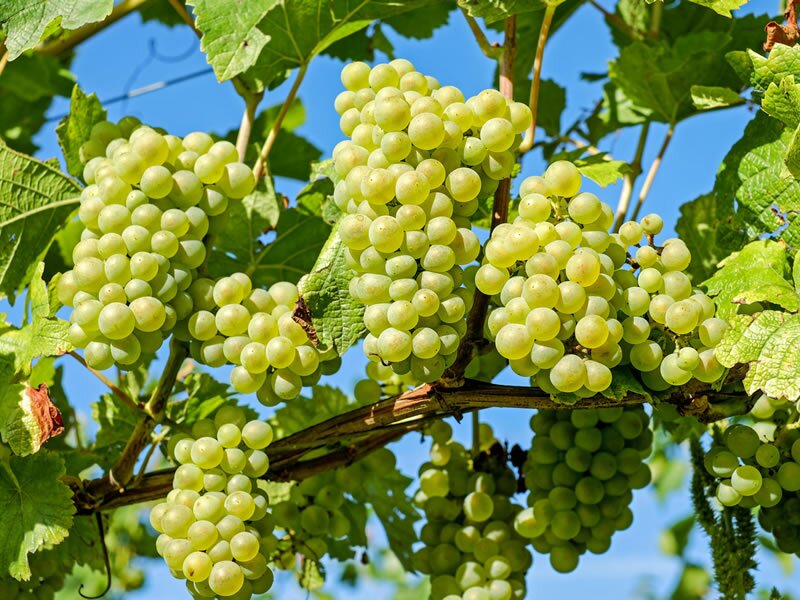
Grapes (Vitis vinifera)
Grapes are a rewarding but often challenging crop to grow in Ireland, particularly in wetter western regions. Traditionally associated with warmer climates, modern varieties bred for cooler conditions now make it possible to grow grapes successfully outdoors in sheltered spots, or more reliably under cover in a greenhouse or polytunnel. It is even possible to grow grapevines in large containers and train them vertically where space is limited.
Success with grapes depends largely on choosing the right variety and providing warmth, shelter and good light. While outdoor growing is possible, growing under cover will generally produce more consistent and sweeter crops. It is also worth managing expectations — grapevines can take a few years to establish before producing a worthwhile harvest, and yields can vary significantly from year to year depending on our often unpredictable weather.
Growing Conditions
- Soil: Well-drained soil that is moderately fertile.
- Light: ull sun, ideally south-facing. A warm wall can make a significant difference by providing extra heat and shelter, often improving yields.
- Shelter: Essential, particularly outdoors
- Spacing: 1.5–2 m between vines. Grapes are self-fertile, so a single plant can produce a good crop over time.
Sowing & Planting
- Grapes are typically grown from young plants rather than seed.
- Plant in spring or early autumn.
- Dig a hole about 50cm deep and incorporate well-rotted manure or compost at the base, along with a few handfuls of grit or gravel to improve drainage.
- Once planted, whilst not essential, vines will benefit from a good 10cm mulch of well-rotted manure or compost, being sure to leave space around the stem to prevent contact and rotting.
- For support you are best to have vines growing laterally on galvanised wires. These should be set at least 15cm away from a wall or fence with a 35cm gap between them, with the bottom wire 40cm or so from the ground.
- Water thoroughly after planting
Outdoor Growing
Growing grapes outdoors in Ireland is possible but requires careful site selection. Choose a warm, sheltered, south-facing wall or fence to maximise heat and protection.
- Ideal for milder areas and good summers
- Train vines against walls or strong supports (see above)
- Prune annually during winter (dormant period) to control growth and encourage fruiting
- Expect variable yields depending on weather
Outdoor Varieties to Try
- Boskoop Glory – One of the most reliable outdoor varieties
- Brandt – Ornamental with edible fruit
- Muscat Bleu – Good flavour and relatively hardy
Growing Under Cover (Greenhouse/Polytunnel)
Growing grapes under cover provides a warmer, more controlled environment and significantly improves the chances of producing sweet, ripe fruit.
- Plant roots inside or just outside the structure, training vines inside
- Train along wires or roof supports
- Prune regularly to control size and improve airflow
- Ventilate well to reduce humidity and disease
Important: Grapevines are vigorous and can quickly dominate a greenhouse or polytunnel. Careful pruning and positioning are essential to avoid excessive shading of other crops such as tomatoes or peppers.
Indoor Varieties to Try
- Thompson Seedless – Popular greenhouse variety
- Black Hamburg – Classic dessert grape
- Himrod – Early, sweet and reliable under cover
Care & Maintenance
- Prune annually in winter or spring to maintain structure
- Train new growth during the growing season
- Water during dry periods, especially under cover
- Feed in spring with a balanced fertiliser. From flowering through to fruiting, apply a fortnightly liquid feed such as seaweed, comfrey, or even a tomato feed to provide a potassium boost for improved fruiting.
Note: Proper training and pruning are essential for productive grapevines. One commonly used method is outlined below.
Training Your Vines
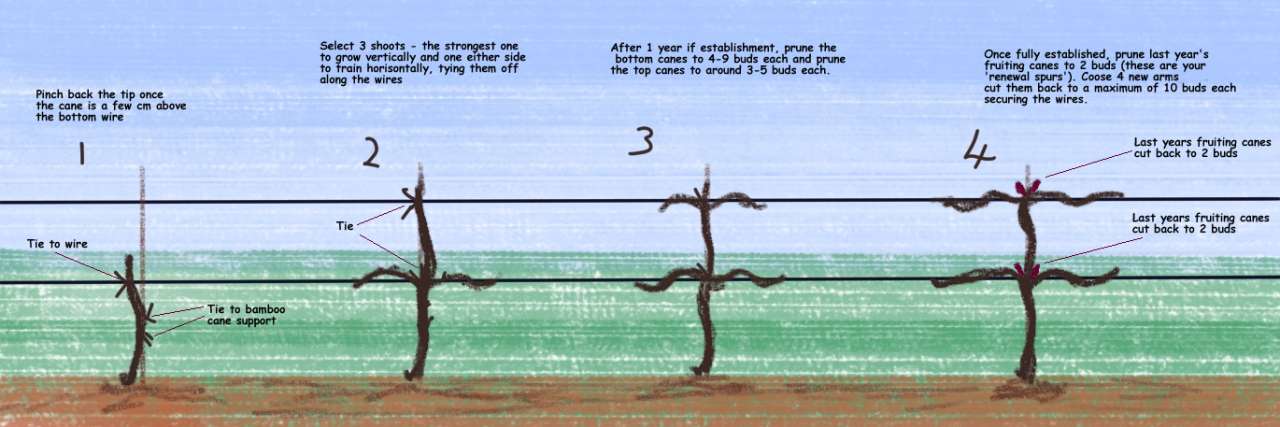
There are a number of ways you can train your grape vines but illustrated above is the 4-Cane Single-Trunk Kniffin method, whereby you train your vines along 2 horizontal galvanised wires. The bottom wire should be at least 45-90cm from the ground with around 35cm between that and the top wire.
- Once you have planted your vine several new shoots will start to develop. Select the strongest shoot and remove all the others, loosely tie the selected shoot to a vertical stake that has been secured to the trellis wires, this will now develop into your main trunk, without energy being wasted on other side shoots. Once this grows about 8-10cm above the lower wire, pinch back the shoot tip to induce branching, leaving two buds above the wire. Several shoots near the top of the cane will develop.
- Select three good shoots to keep, training one to grow vertically and 1 either side to train horizontally along the bottom wire. You will need to secure the two lateral shoots periodically (every couple of weeks or so) to train them along the wire. Remove any other side shoots that may appear along the trunk as you want all the energy now to go into these 3 shoots, the vertical and horizontal ones you are now training.
- Timing of pinching back the vertical trunk at the second wire depends on when the branch reaches the top wire. If the vertical shoot reaches the top trellis wire late in the first growing season, wait to top the shoot until late winter, early spring during the dormant season. If the main shoot does not reach the top wire early enough just continue training the cane to the top trellis wire in the second season. If any fruit clusters develop during the establishment year(s), remove them. This will allow the vine to put its energy into developing a good root system and structure.
- Once established prune the previous year's fruiting canes to just two buds. Select four new shoots, one to grow along either side of the trunk on each wire, to train along each wire and cut them back to a maximum of 10 buds each. These side shoots will produce your grapes.
For subsequent years keep one shoot from the base of each cane (near the trunk) as the new fruiting wood and another as the renewal spur (which will produce the canes for next years production). Cut back the newly selected fruiting wood to no more than 10 buds. When selecting the canes to keep, look for ones that are healthy, about a pencil width in diameter and do not have abnormally long spaces between buds. For the renewal spur, cut this back to two or three buds, these will develop into two or three shoots from which you can then select the best one for your following year's fruiting cane and another for your subsequent renewal spur (discarding the weakest and cutting it back if you originally cut back to three buds).
Note: A fully mature, healthy grape plant should be able to support a maximum total of 40 buds (10 on each of the four fruiting canes) any more than this will reduce fruit quality and open the plant to more risk of injury or disease over winter as it's food stores will be depleted.
Growing in Containers
- This is possible with careful management. Use a large container (around 30L) and ensure excellent drainage.
- Trellises and stakes can be used to then train your vines
- Provide strong supports
- Water and feed regularly
Harvesting
Harvest from late summer to autumn when grapes are fully coloured and sweet. Taste is the best indicator of ripeness.
Common Problems
- Poor ripening: Often due to lack of warmth or sunlight
- Mildew: Can affect leaves and fruit in humid conditions
- Overcrowding: Leads to poor airflow and reduced fruit quality
- Excess growth: Requires regular pruning and training
Culinary Use
- Eaten fresh
- Juices and preserves
- Salads and desserts
- Cheese pairings
Recipe – Roasted Grapes with Honey & Thyme
Ingredients
2 bunches grapes
1 tbsp honey
Fresh thyme
Olive oil
- Toss grapes with honey, thyme and a little oil.
- Roast at 180°C for 15–20 minutes.
- Serve warm with cheese or meats.
Inspired by simple seasonal recipes.
Nutritional Information
- Rich in antioxidants
- Contains vitamin C
- Source of natural sugars for energy