

Pears
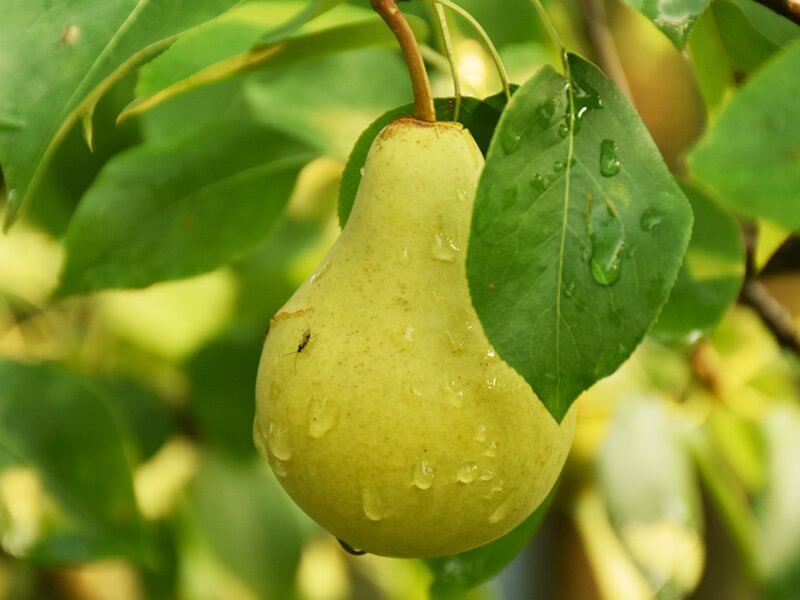
Growing Pears (Pyrus) in Ireland
There is something particularly satisfying about growing your own pears. A healthy pear tree is attractive in its own right, with beautiful spring blossom and good autumn colour, but the real reward comes later in the year when the tree produces its crop of sweet, juicy fruit.
Pears are also a very good choice for an Irish garden, but they do have some particular requirements that are worth considering before you choose a variety. In many respects, they need a similar approach to plums: a sunny, sheltered position is particularly important, and protecting the blossom from cold winds and late frosts can make a significant difference to the eventual crop.
This is especially relevant in the west of Ireland, where spring weather can be cool, wet and windy. Pears flower earlier than apples, so their blossom can be exposed to difficult conditions at a time when pollinating insects may also be less active.
Choosing a Pear Tree for an Irish Garden
When choosing a pear, it is worth considering more than simply how the fruit tastes. The variety, flowering period, pollination requirements, eventual size and the position available in your garden can all affect how well it performs.
Give your pear the best position you can
Pears appreciate warmth and sunshine, so choose the sunniest and most sheltered position available.
A south- or west-facing wall or fence can be particularly useful, providing protection from prevailing winds while also creating a warmer microclimate. This is especially valuable while the tree is in flower.
Strong winds can damage delicate blossom and, just as importantly, discourage bees and other pollinating insects from visiting the flowers. A cold, wet and windy spell during flowering can therefore result in much poorer fruit set even when the tree itself is perfectly healthy.
Where space permits, a pear can be particularly well suited to fan training or growing as a cordon against a wall. Apart from making excellent use of limited space, training the tree against a sunny wall can provide exactly the sort of sheltered conditions that pears appreciate.
Late frosts are another consideration
Because pears flower relatively early in the season, their blossom can be damaged by late frosts. A severe frost at the wrong time can destroy flowers that would otherwise have developed into fruit.
You cannot control the weather, of course, but you can stack the odds in your favour by choosing a suitable site. A sheltered position, particularly against a sunny wall, can offer some protection, while avoiding frost pockets in the lowest parts of the garden is also sensible.
Where you are choosing between varieties, it is worth looking at their flowering characteristics as well as their eating qualities. However, flowering time is only one part of the equation: a well-positioned tree of a reliable variety can crop very successfully, even when conditions are not perfect.
Pollination
Pollination deserves particular attention with pears because many varieties are not fully self-fertile. If a pear requires a pollination partner, you will normally need another compatible pear cultivar flowering at a similar time to provide the pollen required for a good crop.
For the most reliable results, check the pollination group when choosing your trees. Ideally, select two compatible varieties that flower at the same time.
Even where a variety is capable of producing some fruit by itself, a suitable second tree nearby can improve the chances of good fruit set. Bees and other pollinating insects do the work, so encouraging pollinators in the garden and providing a sheltered position where they can work comfortably can be just as important as choosing the right varieties.
It is also worth remembering that a pear in a neighbouring garden may be enough to provide a useful source of pollen. You do not necessarily need to plant two pear trees yourself if there are compatible pears growing nearby.
Popular Pear Varieties to Consider
There are many pears to choose from, ranging from early-season varieties that can be harvested in late summer to excellent late-season cultivars that ripen through autumn. Rather than suggesting that there is one “best” pear, the following are useful varieties to consider for different situations and preferences.
‘Doyenné du Comice’ – Exceptional flavour for a good position
Type: Dessert pear
Pollination group: 4
Fruit: Large, exceptionally juicy and sweet
Season: Late October to November
Particular strengths: Outstanding flavour, late season, excellent dessert pear
‘Doyenné du Comice’ is one of the classic pears for anyone who puts flavour above everything else. Its large fruits have a fine texture and exceptionally juicy, sweet flesh, making it a superb dessert pear when allowed to ripen properly.
It is a late-season variety, so it is particularly useful if you want to extend the pear harvest into autumn. It is also worth remembering that it belongs to pollination group 4 and needs a suitable compatible partner.
Like all pears, it will appreciate a warm, sheltered position. If you have a good south- or west-facing wall, this is the sort of variety that can make excellent use of it.
‘Onward’ – Hardy and reliable
Type: Dessert pear
Pollination group: 4
Fruit: Juicy, melting flesh with excellent flavour
Season: September to October
Particular strengths: Hardy, reliable, excellent flavour
‘Onward’ is a very good choice for an Irish garden, particularly if you are looking for a hardy and reliable dessert pear. It produces juicy fruits with a soft, melting texture and excellent flavour when properly ripened.
It is important to clarify that, despite sometimes being described as a useful choice for cooler gardens, ‘Onward’ is not a late-flowering variety. It flowers early and therefore still benefits greatly from a sheltered position away from cold winds and frost pockets.
It is also worth noting that ‘Onward’ and ‘Doyenné du Comice’ should not be relied upon to pollinate one another, despite both being in pollination group 4. If growing these varieties together, choose another suitable pollination partner as well.
‘Conference’ – A dependable all-rounder
Type: Dessert pear
Pollination group: 3
Fruit: Medium-sized, sweet and juicy
Season: October to November
Particular strengths: Reliable, good flavour, useful for eating and cooking
‘Conference’ is one of the best-known pears for the home garden and remains popular for good reason. It is a reliable cropper producing sweet, juicy fruit that can be eaten fresh but is also useful for cooking.
It is a particularly sensible choice if you want one of the more dependable traditional pears, although as with all pear trees, it should be given as much shelter and sunshine as your garden allows.
Its popularity also means that it is often a useful pollination partner for other pears, provided their flowering periods and pollination groups are compatible.
‘Concorde’ – Compact and versatile
Type: Dessert pear
Pollination group: 3
Fruit: Sweet, juicy and aromatic
Season: October to November
Particular strengths: Compact habit, good flavour, suitable for smaller gardens
‘Concorde’ is a particularly useful choice where space is limited. It produces attractive, sweet fruit and has a relatively compact habit compared with some more vigorous pears.
It can also be trained into restricted forms, making it worth considering for smaller gardens or for growing against a wall or fence.
‘Beth’ – An earlier pear for a shorter season
Type: Dessert pear
Pollination group: 3
Fruit: Small to medium-sized, sweet and juicy
Season: Early to mid-September
Particular strengths: Early season, excellent for eating fresh
‘Beth’ is useful if you want an earlier pear rather than concentrating your entire harvest into October and November.
Early pears can be particularly useful in a smaller garden because they provide fruit at a different time from later varieties. They also have the advantage of being harvested before the weather becomes increasingly autumnal.
‘Williams’ Bon Chrétien’ – Classic flavour and versatility
Type: Dessert / dual-purpose pear
Pollination group: 3
Fruit: Sweet, juicy with a distinctive musky flavour
Season: Mid-September
Particular strengths: Excellent flavour, useful fresh or cooked
‘Williams’ Bon Chrétien’, often simply called ‘Williams’, is one of the classic pears and is valued for its distinctive flavour and juicy flesh.
It is useful both as a dessert fruit and for cooking, although it is not the longest-storing pear. Like other pears, it should be harvested before it becomes fully ripe on the tree and allowed to finish ripening indoors.
‘Pitmaston Duchess’ – A late-season dual-purpose pear
Type: Dual-purpose pear
Pollination group: 4
Fruit: Large, juicy, melting flesh
Season: October to November
Particular strengths: Late season, good for eating and cooking, vigorous
‘Pitmaston Duchess’ is an interesting choice if you want a later pear with uses beyond simply eating fresh. Its juicy, melting flesh makes it suitable for desserts while also being useful in the kitchen.
It is a vigorous tree, so it is better suited to gardens where there is sufficient room for it to develop.
Is it Worth Growing More Than One?
This is perhaps a more important question with pears than with many other fruit trees.
Growing two compatible pear varieties can certainly improve pollination and give you a more reliable crop, particularly where there are few other pears nearby. However, there is another consideration: what are you going to do with all the fruit?
A mature pear tree can produce a surprisingly generous crop, and pears tend to ripen relatively quickly once brought indoors. Unless you have good cool storage or are planning to preserve a proportion of your harvest, two or three trees with similar harvesting periods could leave you with a very substantial glut.
If you do have room for several pears, it may therefore be more useful to choose varieties with different harvesting seasons rather than several trees that all ripen at the same time.
An early pear such as ‘Beth’, followed by a mid-season variety such as ‘Williams’ and then a later variety such as ‘Conference’ or ‘Doyenné du Comice’, could give you a much longer harvest period.
Remember, though, that pollination groups still need to be considered. A later harvest date does not necessarily mean a later flowering date, and two varieties need to flower at compatible times if they are to pollinate one another.
Harvesting Pears – Don't Wait Until They Are Ripe
One of the most important things to understand about growing pears is that they are generally harvested before they are fully ripe.
Unlike many fruits, pears often do not develop their best texture if they are simply left to ripen completely on the tree. Instead, they are picked while still firm and allowed to finish ripening indoors.
Early varieties may need only around a week to ripen after picking, while some later varieties can take considerably longer. The exact timing varies with the variety and the conditions in which the fruit is stored.
When a pear is ready to pick, it should be full-sized and firm, and the fruit should usually come away from the tree with a gentle lift and twist rather than requiring force. If you wait until the fruit is soft on the tree, you may already have missed the ideal harvesting point.
How to ripen pears
Bring harvested pears indoors and keep them somewhere cool and dark until they begin to ripen. Check them regularly, as once they begin to soften they can move from perfectly ripe to over-ripe surprisingly quickly.
For eating, a gentle softness around the neck of the pear is often a useful indication that it is ready. Some varieties may require longer storage before they are ready to eat, so keep a close eye on them rather than relying solely on a calendar date.
Can Pears Be Stored?
Yes – but storage is more complicated than simply putting a basket of pears somewhere and forgetting about them.
Some later pear varieties can be stored for several weeks or even a few months under suitable cool, dark and well-ventilated conditions. However, pears need to be checked regularly because they can ripen rapidly once the process begins.
If you have a suitable cool, frost-free place such as a garage, shed or cellar, store sound, undamaged pears in a single layer without allowing them to touch. Remove any fruit showing signs of rot immediately.
For most home gardeners, however, the easier approach is simply to harvest in stages and enjoy the pears as they ripen, while preserving some of the surplus.
What Can I Do With a Pear Glut?
Fortunately, pears are extremely versatile in the kitchen, and preserving some of the crop can turn a short period of abundance into something you can enjoy throughout the winter.
Mulled pears
Pears can be gently poached in a spiced wine or fruit-based syrup flavoured with ingredients such as cinnamon, cloves, star anise, orange and vanilla. Served warm or chilled, they make an excellent autumn or winter dessert.
Spiced preserved pears
Firm pears can be preserved in a spiced syrup with ingredients such as cinnamon, cloves, ginger, star anise or citrus peel. They make an excellent accompaniment to winter desserts and can also work surprisingly well alongside cheese.
Pears in sugar syrup
A simple sugar syrup is another traditional way of preserving pears. Peel and prepare firm pears, then gently poach them in syrup before preserving them in suitable sterilised jars. The pears can then be used later for desserts, crumbles, tarts and other recipes.
Other ideas
- Poached pears with chocolate, vanilla or spices.
- Pear and apple crumble.
- Pear and ginger cake.
- Pear chutney.
- Pear and walnut salad.
- Pear and blue cheese combinations.
- Pear purée for desserts.
- Freezing prepared pears for later cooking.
Growing a pear tree does not have to mean eating pears for weeks until you can't face another one. A little planning and preserving can make a glut a very welcome part of the autumn harvest.
Pruning Pear Trees
Pears respond well to regular pruning and can be trained into a wide range of useful forms. Bush trees are suitable for more traditional gardens, while pyramids, cordons, fans and espaliers can make excellent use of smaller spaces.
For a small garden, a single cordon can be particularly useful, allowing a productive pear tree to occupy surprisingly little ground. A fan-trained tree against a wall or fence can also be very attractive and can make the most of a warm, sheltered position.
The exact pruning method depends on the form of tree you have chosen. Pears are generally spur-bearing, and pruning should be carried out with the eventual shape and fruiting habit of the tree in mind rather than simply cutting back anything that looks untidy.
For more information on growing fruit trees generally, including choosing rootstocks, planting, staking, feeding and watering, see our guide to Growing Fruit Trees.
Common Problems
Frost damage to blossom
As discussed above, early flowering makes pears particularly vulnerable to late frosts. A sheltered position is one of the best ways to reduce the risk. Smaller trained trees can also sometimes be protected with horticultural fleece if a severe frost is forecast while they are in flower.
Pear scab
Pear scab can cause dark lesions on leaves and fruit, particularly in damp conditions. Good airflow around the tree, sensible pruning and removing affected fallen leaves and fruit can all help reduce problems.
Pear rust
Pear rust causes distinctive orange or reddish markings on pear leaves and can sometimes be unsightly. The disease has a complex life cycle involving junipers, so removing heavily affected material and maintaining good general tree health are useful preventative measures.
Wasps and birds
Once pears begin to ripen they can attract wasps and birds. Harvesting promptly as fruit reaches the correct stage can reduce losses, particularly where fruit is already damaged.
Brown rot
Brown rot can affect ripening fruit, especially during damp weather. Remove affected fruit as soon as it is noticed and do not leave rotten fruit hanging on the tree or lying beneath it.
Final Thoughts
Pears can be extremely rewarding fruit trees for an Irish garden, but they benefit from a little more thought about position and variety than their easy-going reputation might suggest.
Give them as much sunshine and shelter as possible, particularly while they are in flower, and consider how exposed your garden is to prevailing winds and late frosts. If space allows, choose compatible varieties carefully so that pollination is reliable, but don't feel that you need several trees simply for the sake of it – one well-chosen pear can provide a very generous crop.
For smaller gardens, trained forms such as cordons, fans and espaliers can make pears particularly versatile. A sunny wall can provide both an attractive growing space and a useful warmer, more sheltered microclimate.
And when harvest time arrives, remember the golden rule with pears: pick them before they are fully ripe and allow them to finish ripening indoors. This gives you a much better chance of enjoying the fruit at its best and, with a little preserving, making your harvest last well beyond the autumn.
For more information on choosing a rootstock, planting, staking, watering, pollination and the general care of fruit trees, see our guide to Growing Fruit Trees.