
Most gardeners recognise a ladybird as a welcome visitor, but far fewer realise that it is actually the larval stage that does much of the hard work. While adult ladybirds certainly feed on aphids and other soft-bodied pests, the larvae are among the most effective natural predators found in the garden. Understanding their lifecycle not only helps us appreciate these remarkable insects, but also shows how working with nature can reduce the need for chemical pest control.
Whether you grow roses, vegetables, fruit bushes or ornamental plants, aphids are an inevitable part of gardening. Fortunately, nature has already evolved an elegant solution. Ladybirds and their larvae have been controlling aphid populations for millions of years, helping to keep garden ecosystems in balance.
In this guide we'll look at the fascinating lifecycle of the ladybird, explore the species found in Ireland and explain how native Two-spot Ladybird larvae (Adalia bipunctata) can be used as a practical and environmentally friendly method of pest control.
Nature has been controlling aphids for millions of years.
Sometimes the gardener's best job is simply to give nature a helping hand.
Ladybirds in Ireland
Ladybirds are among Ireland's best-loved insects, yet many gardeners are surprised to learn just how many different species occur here.
According to the Irish Wildlife Trust Ladybird Survey conducted in 2014, 18 species of ladybird have been recorded in Ireland, with 15 species recorded during the survey period.1
The survey invited members of the public, schools, naturalists and community groups to record ladybird sightings throughout the country, providing an important snapshot of the distribution of Ireland's ladybird populations.
Some of the more familiar species include:
- Seven-spot Ladybird (Coccinella septempunctata)
- Two-spot Ladybird (Adalia bipunctata)
- Orange Ladybird (Halyzia sedecimguttata)
- Pine Ladybird (Exochomus quadripustulatus)
- Harlequin Ladybird (Harmonia axyridis) (an introduced species)
While records tend to be more widespread across eastern parts of Ireland, ladybirds can be found throughout the country wherever suitable habitat and food sources exist.
Releasing native Two-spot Ladybird (Adalia bipunctata) larvae into gardens with established aphid populations can help reinforce local populations of this beneficial native species while providing an effective, natural form of pest control. Combined with wildlife-friendly gardening practices, it can also help create gardens that better support biodiversity as a whole. Note: These can mature red with two black spots or black with two red spots.

From left to right - Ladybird Eggs on a Plum Tree - Photo by David Short (CC BY-SA 2.0), 7-Spot Ladybird Larvae - Photo by Gilles San Martin (CC BY-SA 2.0), Ladybird pupa - Photo by gailhampshire (CC BY-SA 2.0), Adult 2-Spot Ladybird - Photo by Wim Rubers (CC BY-SA 4.0) and Adult 7-Spot Ladybird - Photo by James K. Lindsey (CC BY-SA 2.5)
Why Ladybirds Matter
Ladybirds are predators. Both adults and larvae feed on a variety of garden pests, including:
- Aphids (greenfly and blackfly)
- Whitefly
- Scale insects
- Small mites
- Insect eggs
Among these, aphids are by far their preferred food source.
Aphids themselves are not necessarily a sign of poor gardening. In fact, they are a natural part of a healthy ecosystem and provide food for many beneficial insects, birds and other wildlife.
The aim is rarely to eliminate aphids completely. Instead, good gardening encourages natural predators that keep aphid populations under control before significant damage occurs.
Did You Know?
A single ladybird larva may consume hundreds of aphids during its development before becoming an adult and over the whole lifecycle of a ladybird this number can reach up to 5000.
The Lifecycle of a Ladybird
Understanding the lifecycle of a ladybird helps explain why larvae are such effective biological controls and helps gardeners to see how this pest controlling bug has a positive effect through the growing season.
The Ladybird Year
🍂 October – February
Adult ladybirds overwinter in sheltered locations including bark crevices, sheds, fences, dense vegetation and leaf litter.
🌱 March – April
Adults emerge and begin feeding after winter.
❤️ May
Male and female ladybirds mate.
🥚 June – July
Females lay clusters of eggs near aphid colonies.
🐊 June – July
The eggs hatch into larvae which begin feeding immediately.
🟠 July – August
Larvae pupate.
🐞 August – September
New adults emerge and continue feeding.
🍂 Autumn
Adults seek shelter and overwinter until the following spring.
Under normal conditions, ladybirds complete their lifecycle within approximately one year.1
Not Every Insect Is a Pest
Don't squash ladybird larvae!
Many gardeners have never seen a ladybird larva before and mistake it for a pest.
Ladybird larvae look nothing like the familiar red adults. They are dark, elongated creatures often marked with orange or yellow patches and are sometimes described as looking a little like miniature alligators.
Despite their appearance, they are among the most beneficial insects you can find in your garden.
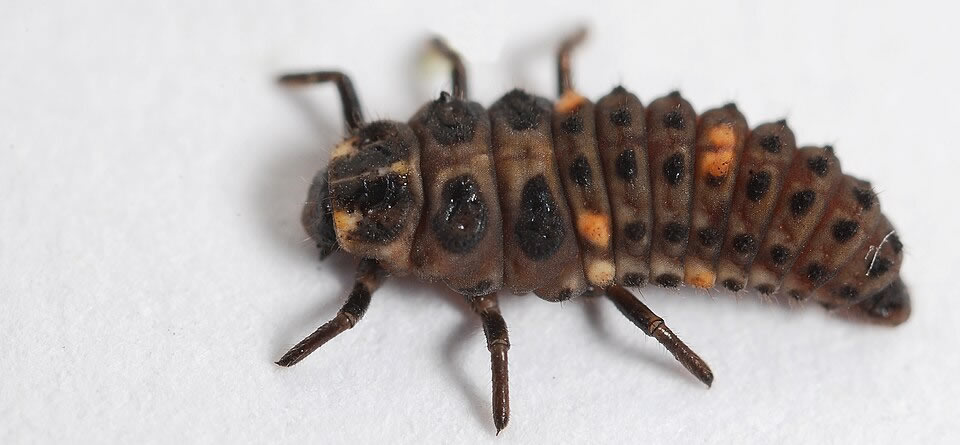
Don't squash these little critters! - Adalia bipunctata (2-spot ladybird) larva- Photo by Gilles San Martin (CC BY-SA 2.0)
Why Use Larvae Instead of Adult Ladybirds?
When gardeners first hear about biological pest control, they often assume that adult ladybirds are the best option. In reality, larvae offer several important advantages.
- Larvae begin feeding almost immediately.
- They consume large numbers of aphids during development.
- They remain close to the food source.
- Unlike adults, they cannot simply fly away after release.
- They establish exactly where aphid populations are causing problems.
For these reasons, native Two-spot Ladybird larvae are widely used as an effective biological control in gardens, glasshouses and growing spaces.
Why Two-spot Ladybirds?
The Two-spot Ladybird (Adalia bipunctata) is a native Irish species, well adapted to feeding on aphids and suitable for use as a biological control in gardens within our climate.
How Many Aphids Can They Eat?
The answer is: quite a lot.
While exact numbers vary depending on conditions and prey availability, a developing ladybird larva may consume several hundred aphids before reaching adulthood.
Because larvae spend almost all of their time feeding and growing, they are remarkably efficient natural predators.
This makes them particularly useful when aphid populations have begun to build on:
- Roses
- Vegetables
- Fruit bushes
- Young trees
- Perennials
- Container-grown plants
By targeting aphid colonies directly, larvae help restore balance naturally without the need for broad-spectrum insecticides.
How to Release Ladybird Larvae
For the best results, ladybird larvae should be released as soon as possible after they arrive, ideally onto plants where aphids are already present. As the larvae feed almost exclusively on soft-bodied insects during this stage of their development, releasing them onto plants without a food source is unlikely to be successful.
Choose a calm, dry day where possible and avoid releasing larvae during heavy rain or strong winds. Early morning or late evening can be ideal, as cooler temperatures reduce the likelihood of the larvae becoming stressed or exposed to direct sunshine.
Before You Begin
- ✔ Identify plants with active aphid colonies.
- ✔ Avoid using insecticides before or after release.
- ✔ Water dry containers or borders beforehand if necessary.
- ✔ Release the larvae as soon as possible after delivery.
- ✔ Spread them across several affected plants rather than placing them all in one location.
The larvae are supplied with a carrier material that helps protect them during transport. Simply sprinkle small quantities directly onto affected plants, ensuring they are placed as close as possible to the aphid colonies.
Watch How We Release Our Ladybird Larvae
Sometimes it's easier to see the process than describe it. In the video below, one of our team, Glen, demonstrates exactly how we prepare and distribute our native Two-spot Ladybird larvae around the garden.
As you'll see, there's no complicated equipment required — simply place the larvae where aphids are already feeding and allow nature to do the rest.
Creating a Ladybird-Friendly Garden
Introducing ladybird larvae is only one part of encouraging natural pest control. The most successful gardens provide an environment where ladybirds and other beneficial insects can thrive throughout the year.
Simple changes can make a remarkable difference.
Helping Ladybirds Stay in Your Garden
- Plant nectar-rich flowers such as Alyssum, Achillea, Dill, Fennel and Marigolds.
- Allow small aphid populations to exist where they are not causing significant damage.
- Avoid broad-spectrum insecticides whenever possible.
- Leave some leaf litter or dense planting for overwintering shelter.
- Include a variety of flowering plants throughout the growing season to support a wide range of beneficial insects.
Gardens managed with wildlife in mind tend to become more balanced over time. Rather than constantly reacting to pest outbreaks, natural predators begin to establish themselves and help maintain healthier populations.
Frequently Asked Questions
Will the larvae eat my plants?
No. Ladybird larvae feed on aphids and other small soft-bodied insects. They do not damage plants.
How quickly do they start feeding?
Almost immediately. Once released near aphid colonies, the larvae begin hunting and feeding straight away.
Can I release them in a greenhouse?
Yes. Ladybird larvae perform particularly well in greenhouses, conservatories and polytunnels where aphid populations often build up quickly.
Will they stay in my garden?
During the larval stage they remain close to their food source. Once they become adults they are free to disperse naturally, although gardens providing food, shelter and suitable habitat are far more likely to retain ladybird populations.
Can I release them during wet weather?
Light showers are unlikely to cause problems, but avoid releasing larvae during prolonged heavy rain where they may be washed from the plants before they establish.
Should I still control every aphid?
Not necessarily. Small aphid populations are an important food source for ladybirds, hoverflies, lacewings and many garden birds. Healthy gardens rarely eliminate aphids altogether; instead, they encourage natural predators to keep numbers in balance.
A Healthy Garden is a Living Garden
It's easy to think of insects simply as pests, but many of the creatures we find in our gardens play important roles in maintaining a healthy ecosystem.
By encouraging beneficial insects such as ladybirds, we can often reduce our reliance on chemical sprays while creating gardens that are richer in wildlife and more resilient over time.
Final Thoughts
Ladybirds have been quietly protecting our gardens for millions of years. By understanding their remarkable lifecycle and providing the right conditions, we can harness one of nature's most effective forms of pest control.
Whether you're growing roses, vegetables, fruit or ornamental plants, introducing native Two-spot Ladybird larvae offers a simple, environmentally responsible way to help restore balance where aphids have become established.
Combined with wildlife-friendly gardening practices, they can become part of a healthier, more sustainable approach to gardening—one that works with nature rather than against it.
Encourage Nature to Do the Hard Work
If aphids have begun appearing in your garden, our native Two-spot Ladybird (Adalia bipunctata) larvae offer an effective and environmentally friendly way to help restore natural balance.
Each pack contains 100 live larvae, ready to be released directly onto affected plants where they begin feeding almost immediately.
Working with nature has never been easier.
1 Ladybird species information and lifecycle summary adapted from the Irish Wildlife Trust Ladybird Survey (2014), a nationwide citizen science project recording ladybird distribution throughout Ireland.