
Understanding Your Soil is the First Step to Gardening Success
Before buying plants or improving your borders, it's worth taking a little time to understand the soil you already have. A couple of simple tests can help you choose plants that will naturally thrive, saving you both money and disappointment in the years ahead.
You don't need to be a soil scientist to learn about your garden. In fact, with a simple pH testing kit and a few observations, you'll soon have a much better understanding of what will flourish in different parts of your garden.
Why Does Soil Matter?
Every plant has its own preferred growing conditions. Some enjoy free-draining sandy soils, while others thrive in heavier clay. Likewise, certain plants prefer acidic soil, whereas others grow best in neutral or alkaline conditions.
Knowing what lies beneath your feet allows you to work with nature rather than against it, giving your plants the best possible start.
What Type of Soil Do You Have?
A simple squeeze test will usually tell you a lot.
| Soil Type | How it Feels | Typical Characteristics |
|---|---|---|
| Clay | Sticky when wet, hard when dry. | Holds moisture well but can drain slowly (Can fall into the 'moist' or 'poorly drained' category in terms of plants). |
| Loam | Crumbly and easy to work. | The ideal balance of drainage and moisture retention (Leans to the 'moist but well drained' side of soil types in plant descriptions). |
| Sandy | Gritty and loose. | Drains quickly and warms up rapidly in spring (Look for plants that like 'well drained' soil for these areas of the garden). |
Most gardens are actually a mixture of different soil types, so don't be surprised if conditions vary from one border to another.
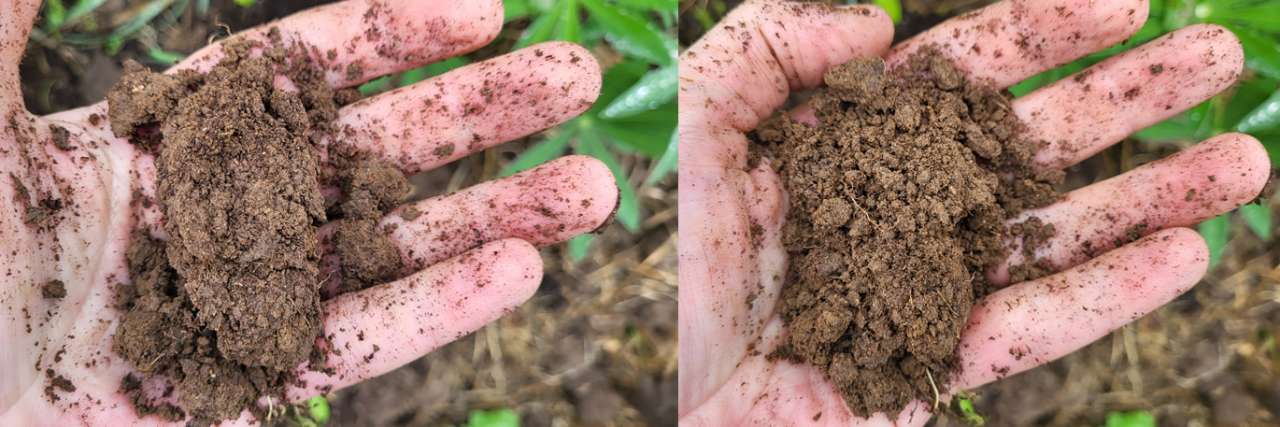
A simple squeeze test can help you identify how heavy your soil is - here (left) the soil holds together after rainfall, but (right) will crumble relatively easily and so indicates a 'loamy' soil. This generally puts it in the 'moist but well drained' category for plant buying. However, my garden is on something of a slope and the area towards the bottom of the gradient has soil which leans more towards the 'clay' end of the spectrum with less drainage. Photo by Richard taken 27/07/2026.
Testing Your Soil pH
As well as soil texture, it's useful to know whether your soil is acidic, neutral or alkaline.
A simple garden pH testing kit is inexpensive, easy to use and gives results within minutes.
- Below pH 7 — Acid soil
- pH 7 — Neutral soil
- Above pH 7 — Alkaline soil
This information helps you select plants that are naturally suited to your garden.
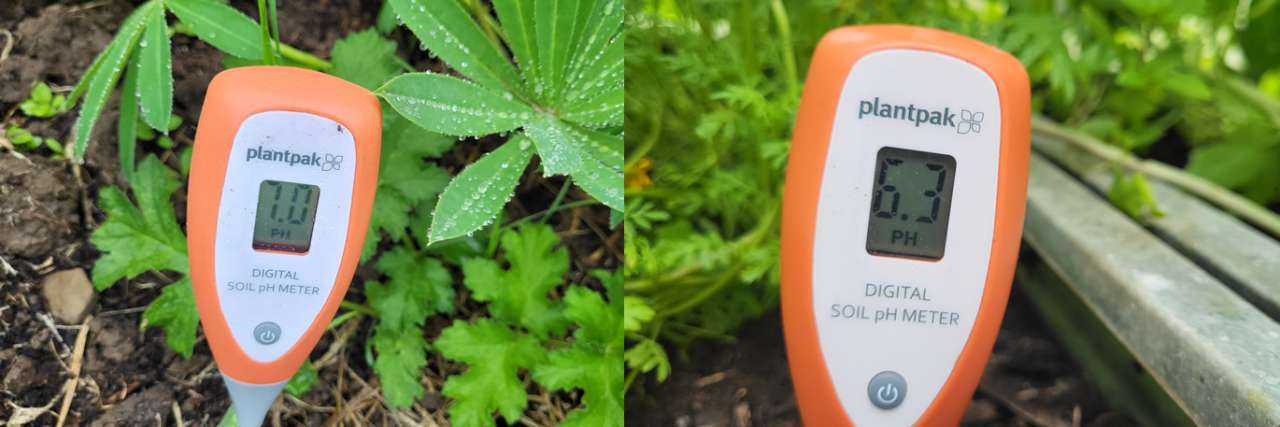
Here I have used a pH meter to test my soil. The first (left) is outside in a garden bed, where a pH of 7.0 indicates a neutral soil whilst the latter reading (right) was taken in a polytunnel bed, where a reading of 6.3 indicates a slightly acidic soil, perfect for my tomatoes. I would say though that pH meters can vary greatly in quality and accuracy. Chemical testing kits are inexpensive, easy to use and often give more reliable results. Photo by Richard (AGC) taken 27/07/2026.
Earthworms are one of the best indicators of healthy soil. If you regularly find worms while digging, it's usually a good sign that your soil contains plenty of organic matter and supports healthy soil life.
Different Parts of the Garden Can Be Different
Even relatively small gardens can contain several different growing conditions.
Areas beneath trees, beside buildings, raised beds or newly landscaped borders may all behave differently.
It's well worth testing soil in several locations and making a simple sketch of your garden with notes such as soil type and pH. You'll soon build a useful reference whenever you're planning new planting.
Can You Change Your Soil?
Improving your soil and changing your soil are two very different things.
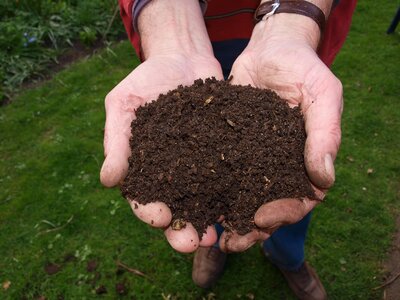
Adding compost, leaf mould or well-rotted manure will greatly improve soil structure, drainage and moisture retention, making it healthier and easier to work.
However, permanently changing your soil's natural pH is much more difficult.
For example, adding ericaceous compost to an alkaline border may help an acid-loving plant for a while, but over time the surrounding soil will naturally influence the planting hole and conditions will gradually return to normal.
Similarly, applying lime to acidic soil can be useful when growing crops such as brassicas, where only a temporary change is needed for the season. It is far less effective as a permanent solution if you're hoping to grow shrubs or perennials that naturally prefer neutral or alkaline soils for many years.
In the long run, the simplest approach is usually to choose plants that suit your soil rather than trying to make your soil suit every plant.
| Improve Your Soil | Choose the Right Plant |
|---|---|
| Add compost to improve soil structure. | Select plants naturally suited to your soil conditions. |
| Use lime temporarily for crops such as brassicas if required. | Grow acid-loving plants in naturally acidic soil wherever possible. |
| Use ericaceous compost in containers. | If your garden soil isn't suitable, containers often provide the perfect alternative. |
When planting something new, I always make a quick note of where it went and what the soil was like in that part of the garden. It only takes a minute, but it makes future planting decisions much easier and helps explain why some plants perform better than others.
Healthy Soil is Always Worth Improving
Whatever type of soil you have, adding organic matter such as compost or well-rotted manure will almost always improve its structure.
- Clay soils become easier to work and drain more freely.
- Sandy soils hold onto moisture for longer.
- Loam soils become even richer and more biologically active.
Think of organic matter as feeding your soil, which in turn helps your plants.
Remember
- Test your soil before buying lots of new plants.
- Different areas of your garden may have different soil conditions.
- The most successful gardens work with their natural soil, not against it.
Find the Right Plants for Your Garden
Whether you're looking for acid-loving shrubs, Mediterranean plants, composts, soil improvers or a simple pH testing kit, our team is always happy to help you choose plants that will thrive in your garden.