
Skimmia is one of those plants that can sometimes be overlooked until autumn and winter, when its glossy evergreen foliage, colourful flower buds and, on female plants, clusters of bright berries really begin to catch the eye. But there is much more to this versatile shrub than its festive-season appeal.
These slow-growing, low-maintenance evergreen shrubs are particularly useful in areas of the garden where other plants can struggle. Their dense, leathery foliage provides year-round structure, while fragrant flowers appear in spring, often opening from attractive pink, red or greenish buds.
For Irish gardens, Skimmia can be especially useful in partial or deeper shade, provided the soil is moisture-retentive without becoming waterlogged. It is also a good choice for containers, particularly where you want dependable evergreen interest without having to constantly maintain the plant.
So, if you have a shady corner that needs a little more structure and interest, Skimmia could be just the plant you are looking for. They also make for a great festive plant with their evergreen leaves and buds or berries produced over the Christmas/Winter season.
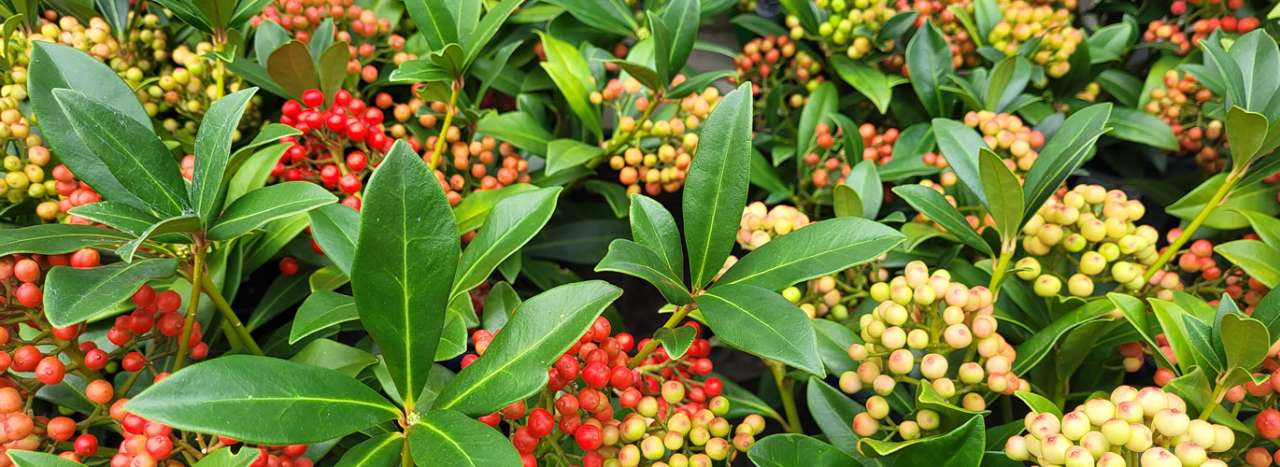
Skimmia Pabella is a female variety of Skimmia, which if planted near a male variety such as Finchy or Rubella, produces berries in autumn that can persist over the festive winter season
- Photo taken at Ardcarne Garden Centre, Boyle on 17/09/2026
Why Grow Skimmia?
One of the great strengths of Skimmia is its ability to provide interest across several seasons without demanding a great deal of attention.
- Evergreen foliage: the glossy, dark green leaves provide structure throughout the year.
- Spring flowers: clusters of small, fragrant flowers appear in spring.
- Colourful buds: many varieties carry attractive red, pink or greenish flower buds before they open.
- Autumn and winter berries: female plants can produce long-lasting red berries following successful pollination.
- Shade tolerance: Skimmia is particularly useful for partial and deeper shade where many flowering shrubs will struggle.
- Low maintenance: these naturally compact shrubs generally require very little pruning once established.
- Container friendly: their relatively slow growth makes them useful for pots and other smaller planting areas.
Perhaps most importantly, Skimmia is a plant that can give a shady garden a sense of permanence. Rather than relying entirely on seasonal flowers, the evergreen framework remains in place throughout the year.
Understanding Male and Female Skimmia
There is one important point to understand when choosing Skimmia, particularly if you are hoping to enjoy the colourful berries: not all Skimmia plants produce berries.
Most Skimmia have separate male and female plants. Male plants produce flowers but do not produce berries, while female plants can produce berries if they are pollinated by a compatible male plant growing nearby.
This is worth considering when choosing plants for your garden. If you particularly want berries, look for a female variety and make sure there is a suitable male Skimmia nearby to provide the pollen it needs.
Want berries?
Choose a female Skimmia such as Skimmia japonica 'Pabella' and plant it close enough to a suitable male variety, such as 'Rubella' or 'Finchy', for pollination to take place.
The male plants are certainly not without merit, however. Their spring flower clusters can be particularly attractive and fragrant, while their evergreen foliage provides exactly the same year-round structure that makes Skimmia so useful.
Where Should You Grow Skimmia?
Skimmia is at its best when grown in partial shade to deeper shade. This makes it particularly useful beneath trees, along north-facing boundaries, in sheltered woodland-style borders or anywhere that receives less direct sunlight.
Although some Skimmia can tolerate sunnier positions, too much direct sun, particularly when combined with dry soil, can cause the foliage to yellow and the plant to become less vigorous. If your garden has a naturally damp, shady area, Skimmia is therefore likely to be a much better fit than trying to force it into a hot, exposed position.
As with so many plants, the key is not simply whether Skimmia can tolerate a particular position, but whether that position provides the conditions in which it will naturally perform well.
Soil – Does Skimmia Need Acidic Soil?
Skimmia is often grouped together with plants such as rhododendrons, azaleas, camellias and pieris, which can lead to the assumption that it must be grown in acidic soil. This isn't quite the case.
Skimmia generally performs well in humus-rich, moisture-retentive soil with good drainage. It prefers acidic to neutral conditions, but can also tolerate alkaline soils where there is plenty of organic matter.
In other words, moisture and soil condition are often more important than simply focusing on pH. A poor, dry soil or a position that is too sunny can lead to yellowing foliage, which is sometimes mistaken for an iron deficiency.
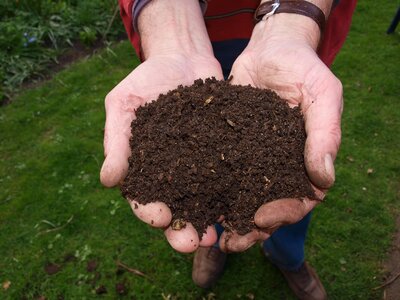
Before planting, improve poor or light soil with plenty of well-rotted organic matter. This helps improve its ability to retain moisture while also improving the overall structure of the soil.
At the same time, avoid planting Skimmia somewhere that remains saturated for long periods. They like moisture, but their roots still need access to air, so good drainage is important.
Planting Skimmia
Container-grown Skimmia can generally be planted whenever the ground is workable, provided the soil isn't frozen or waterlogged. Autumn and spring are particularly convenient times for planting, when natural moisture levels tend to be more reliable.
Choose a sheltered position in partial or deeper shade and prepare the ground by incorporating well-rotted organic matter where necessary.
When planting, make sure the Skimmia is positioned at approximately the same depth as it was growing in its original container. Firm the soil gently around the rootball and water thoroughly.
Although Skimmia is relatively low maintenance once established, don't underestimate the importance of watering during the first year, particularly through prolonged dry spells.
Growing Skimmia in Containers
Skimmia is also an excellent container plant, particularly for shady patios, entrances, courtyards and areas close to the house.
Choose a good-quality, moisture-retentive multipurpose compost and make sure the container has adequate drainage. Adding some loam-based compost can help provide additional structure and moisture retention.
When potting on, there is no need to move the plant into a dramatically larger container. A pot only a few centimetres wider than the existing rootball is generally sufficient, allowing the compost around the roots to remain reasonably manageable.
Remember that containers dry out much more quickly than garden soil, even when positioned in shade. Regularly check the compost during dry weather rather than relying on rainfall alone.
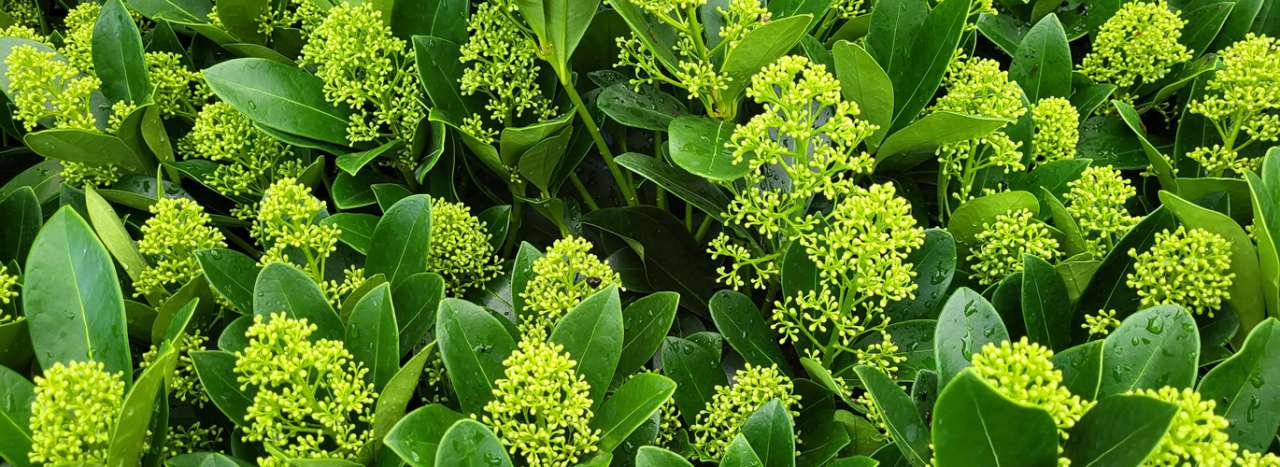
Skimmia Finchy is a male variety of skimmia with attractive lime green buds over winter, which open to a mass of fragrant creamy-white flowers in spring that are loved by pollinators and help provide nearby female Skimmia with berries later in the year
-Photo taken at Ardcarne Garden Centre, Boyle on 17/09/2026
Skimmia Care
Once established, Skimmia requires surprisingly little attention. The main thing to watch is moisture.
Water newly planted Skimmia during dry spells until the roots have become established. Container-grown plants will need more regular attention, particularly during summer, as their available root space is restricted and containers can dry out quickly.
An annual mulch of well-rotted organic matter can be beneficial. This helps maintain moisture levels and gradually adds organic matter to the soil. Keep the mulch slightly away from the base of the plant to avoid creating persistently wet conditions around the stems.
Most established plants growing in reasonably fertile soil should not require regular feeding. If the soil is particularly poor, a general fertiliser applied in spring can provide additional support.
Does Skimmia Need Pruning?
Generally, no.
One of the advantages of Skimmia is that it naturally forms a neat, rounded shrub and usually needs little intervention. If pruning is necessary to maintain its shape or remove damaged growth, it is best carried out after flowering.
Avoid treating Skimmia like a shrub that needs regular hard pruning. Its slow growth and naturally compact habit mean that a light touch is usually all that is required.
Skimmia We Love This Season
These are three varieties we particularly like for their combination of evergreen foliage, spring interest and usefulness in shady Irish gardens. They also demonstrate why understanding whether a Skimmia is male or female can be important when choosing plants.
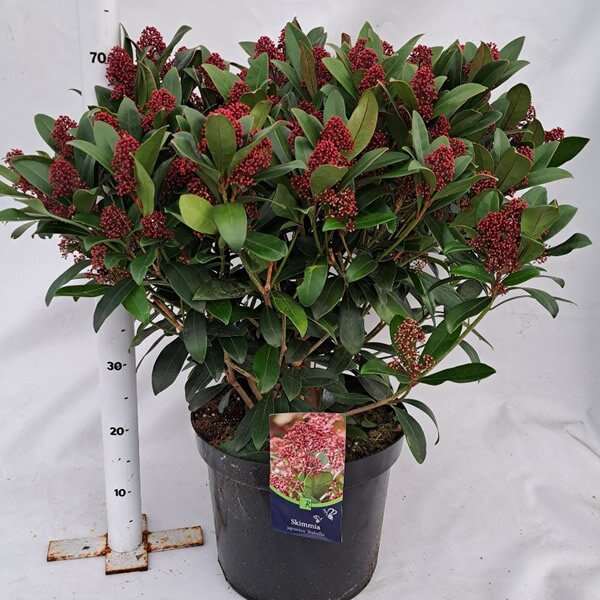
Skimmia japonica 'Rubella'
Male variety
'Rubella' is a compact, bushy evergreen with dark green foliage and particularly attractive deep red flower buds. These open to fragrant white flowers in early spring, providing a welcome burst of interest after the darker months of winter.
As a male variety, 'Rubella' does not produce berries itself, but it can play an important role in pollinating nearby female Skimmia. Its combination of colourful buds, fragrant flowers and evergreen foliage also makes it an attractive plant in its own right.
Plant it in partial shade with moisture-retentive, well-drained soil where its dark foliage and colourful buds can be appreciated throughout the seasons.
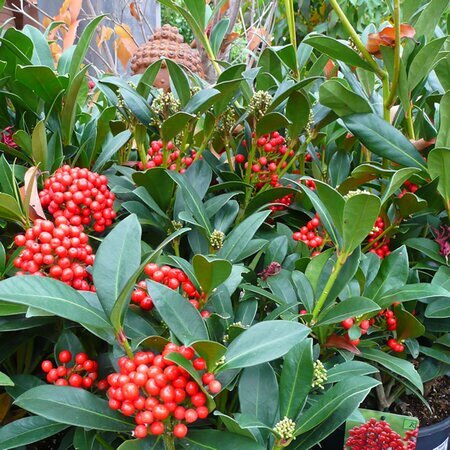
Skimmia japonica 'Pabella'
Female variety – red berries
'Pabella' is a bushy evergreen Skimmia with glossy, dark green leaves and fragrant white flowers in spring. Following successful pollination, the flowers develop into green berries which gradually ripen to a bright red during autumn.
The berries persist through winter, making 'Pabella' particularly useful where you want a plant that continues to provide colour and structure after many of the summer-flowering plants have disappeared.
For reliable berry production, plant 'Pabella' close to a suitable male Skimmia such as 'Rubella' or 'Finchy'.
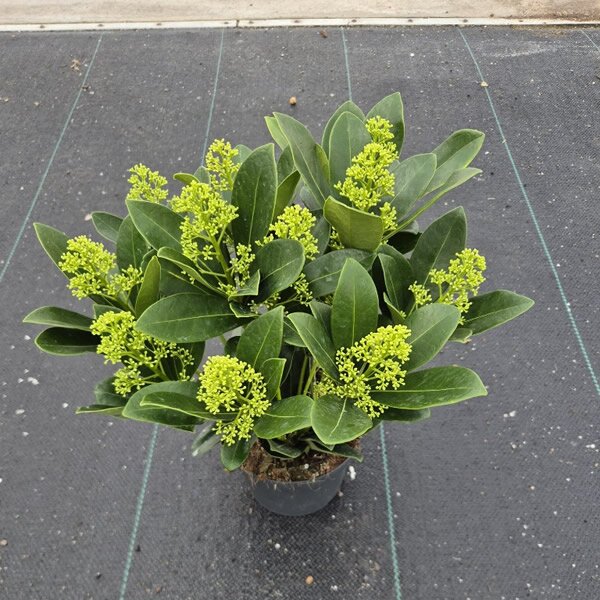
Skimmia japonica 'Finchy'
Male variety
'Finchy' is a compact evergreen Skimmia with glossy, dark green foliage and dense clusters of small, fragrant, creamy-white flowers in spring.
Its relatively compact habit makes it useful in smaller borders and containers, while its flowers provide an additional reason to grow male Skimmia beyond simply their role in pollination.
Like 'Rubella', 'Finchy' is a male plant and therefore will not produce berries itself, but it can provide pollen for nearby female Skimmia.
Using Skimmia in the Garden
Skimmia's evergreen habit and preference for shade make it remarkably versatile.
Shady Borders
Perhaps its most natural home is in a shaded border, where the glossy evergreen foliage provides a dependable framework among ferns, hellebores, spring bulbs and other shade-tolerant perennials.
Because Skimmia is slow growing and naturally rounded, it can also be used to provide structure without overwhelming the planting around it.
Containers
Skimmia works particularly well in containers where you want reliable foliage through autumn and winter. Female varieties such as 'Pabella' can add another seasonal layer with their red berries, while male varieties provide attractive flower buds and fragrant spring flowers.
Woodland-Style Planting
The dark green foliage of Skimmia works beautifully alongside the softer textures of ferns, hellebores and other woodland-style plants. It can also be combined with spring bulbs to create a planting scheme that changes as the seasons progress.
Contrasting Foliage
Because Skimmia has relatively solid, glossy green foliage, it provides a useful backdrop for plants with contrasting leaf shapes and colours. Heucheras, for example, can introduce a range of foliage colours around the base of Skimmia, while low-growing heathers can add a different texture and seasonal interest.
Skimmia Companions
Skimmia can be incorporated into many different planting styles, and its companions don't necessarily need to be acid-loving plants.
In suitable soils, it can be combined with rhododendrons, azaleas, camellias and pieris to create a classic woodland or woodland-edge planting scheme.
For a more foliage-led combination, the glossy green leaves of Skimmia contrast particularly well with the coloured foliage of heucheras.
Low-growing heathers can introduce contrasting texture and colour, while red-stemmed Cornus can make a particularly attractive winter combination with a female, red-berried Skimmia.
Common Skimmia Problems
Yellowing Leaves
Yellowing leaves are one of the most common concerns with Skimmia and are often assumed to indicate an iron deficiency or unsuitable soil pH.
Before reaching for a fertiliser, look at the growing conditions. Dry soil, poor soil and too much direct sun can all cause Skimmia to develop yellowing foliage. Check the moisture levels first and consider whether the plant is receiving more sun than it really wants.
Drying Out
Skimmia prefers consistent moisture, particularly while becoming established. If the leaves begin to yellow or the plant starts looking stressed during dry weather, check the soil around the rootball rather than relying on surface moisture alone.
A good organic mulch can help reduce moisture loss, while container-grown plants will need more frequent watering.
Waterlogged Soil
Although Skimmia likes moisture, this doesn't mean it wants to sit in saturated ground. Persistently waterlogged soil can create problems for the roots, so make sure the planting area has reasonable drainage.
No Berries
If your female Skimmia flowers but doesn't produce berries, check whether there is a compatible male plant nearby. Female plants need pollen from a male Skimmia in order to set berries, with the exception of self-fertile forms such as Skimmia japonica subsp. reevesiana.
This is one reason it is worth checking the plant label when buying Skimmia rather than simply choosing a plant based on its appearance.
Propagating Skimmia
If you want to try propagating Skimmia yourself, cuttings are the most practical method for the home gardener.
Softwood or semi-ripe cuttings can be taken during the growing season, while hardwood cuttings can also be attempted later in the year. Choose healthy, non-flowering shoots and remove the lower foliage, leaving a small amount of leaf growth at the top.
Insert the cuttings into a free-draining cutting compost and keep them in a sheltered environment with sufficient humidity while they develop roots. Several cuttings can be placed around the edge of a pot, allowing you to increase your chances of success.
As with any propagation project, patience is important. Skimmia is a slow-growing shrub, so newly rooted cuttings will take time to develop into substantial plants.
Final Thoughts
Skimmia may be best known for its red berries and its appearance in autumn and winter displays, but its real value is its ability to provide year-round structure in places where many other shrubs struggle.
It is evergreen, naturally compact, relatively low maintenance and particularly well suited to partial and deeper shade. Add fragrant spring flowers, colourful buds and, where appropriate, winter berries, and it becomes a plant that offers considerably more than its first impression might suggest.
As always, the key is to choose a plant that suits the conditions you already have. Give Skimmia a position with adequate moisture, good drainage and protection from excessive sun, and it can provide dependable interest for many years.
And if berries are part of the attraction, remember to check whether you are buying a male or female variety – sometimes choosing the right combination of plants is just as important as choosing the individual plant itself.
Looking to add some evergreen structure to a shady area of your garden?
Explore our range of Skimmia online or call into our garden centres in Boyle or Roscommon Town, where our team will be happy to help you find a variety suited to your garden.