
Choosing the Right Lights for Your Tree and Home
Few things change the atmosphere of a room quite like switching on the Christmas tree lights. But choosing a set can be surprisingly confusing. What is the difference between basic, compact and cluster lights? How many LEDs do you actually need? And will leaving them on each evening make a noticeable difference to your electricity bill?
Fortunately, modern LED Christmas lights have made it easier to enjoy a welcoming glow without using a great deal of electricity. The trick is to choose the effect you like, check the specifications and think about where and how you will use the lights. Here is our practical guide to making an informed choice, whether you are lighting a small tree, a full-sized family Christmas tree or a few features around the home and garden.
1. Basic, Compact or Cluster: What's the Difference?
These names describe how closely the individual LEDs are positioned, rather than how powerful they are. Lumineo, whose Christmas lights we stock at Ardcarne, distinguishes between three popular arrangements:
Basic lights: a classic, gently spaced glow
On Lumineo's basic lights, the LEDs are approximately 7.5cm apart. This gives a more traditional, widely spaced effect and makes it easy to wind the string through the branches. A good option if you prefer to see plenty of greenery and individual points of light.
Compact lights: a fuller sparkle
Lumineo compact lights place LEDs approximately 2.2cm apart. With more lights close together along the string, they create a denser, more continuous sparkle. They suit anyone who likes a well-lit tree without necessarily choosing the most elaborate look.
Cluster lights: a richly illuminated effect
Cluster lights have LEDs grouped extremely close together, creating a concentrated, almost sparkling ribbon of light. They can look particularly dramatic on a tree, garland or other feature, although you may not need as much lit cable to achieve the effect you want.
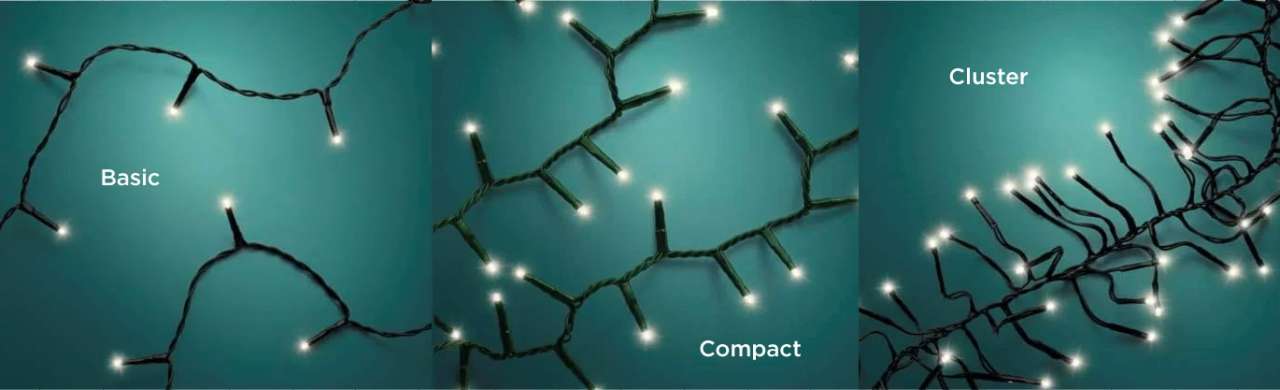
Basic, Compact & Cluster Lights - Images courtesy of Lumineo
2. How Many Lights Do I Need for My Christmas Tree?
There is no perfect number. A narrow tree needs fewer lights than a broad, densely branched tree of the same height, and a softly lit tree needs fewer than one intended to sparkle from every angle. As a starting point for a relatively gentle, traditional effect, Lumineo suggests the following approximate LED counts:
| Tree height | Suggested starting point |
|---|---|
| Up to 1.5m (about 5ft) | 100–150 lights |
| 1.5–2m (about 5–6½ft) | 200–300 lights |
| 2–3m (about 6½–10ft) | 400–600 lights |
| Over 3m (about 10ft) | Start at 600 and adjust to suit the tree |
These are guidelines, not a rule or a recommended count for every lighting style. Compact and cluster sets often contain many more LEDs over a shorter length, so their bulb counts cannot be compared directly with basic lights. If you like a very bright, layered effect, you may choose considerably more. If you prefer a simpler tree, fewer lights can look lovely.
Before buying, measure the height and consider the width of your tree, check how many metres of the set actually illuminate, and picture the result you want. If the tree stands against a wall, you may also decide to concentrate more light on the sides you see most often.
3. How to Put Lights on a Christmas Tree
Test the lights before winding them around the tree. If it is an artificial tree, shape and open the branches first. Start near the bottom, distributing the cable around the tree and bringing some LEDs towards the trunk and others nearer the branch tips. This helps create depth rather than a single bright spiral around the outside.
Work steadily, step back from time to time and adjust any obvious gaps. Avoid pulling cables tightly, trapping them in hinged branches or hanging heavy decorations from the light cable. For a more elaborate decorating method, see our guide to decorating your Christmas tree, which includes the Everlands six-step approach as well as simpler alternatives.
4. Are LED Christmas Lights Expensive to Run?
Compared with older filament-style Christmas lights, modern LEDs generally use much less electricity. Lumineo estimates that running LED Christmas lighting for eight hours a day over 30 days costs around €0.50 on average. That is an encouraging illustration of how efficient LED lighting can be, but it is not a guarantee for every set. Your actual cost depends on the wattage of the lights, how long they are switched on and your electricity unit rate. Lumineo's lighting FAQ explains their estimate.
Watts, kilowatts and kilowatt-hours: the simple explanation
The important number to look for on the packaging or product information is the power consumption, usually shown in watts (W). Your electricity supplier charges for energy used in kilowatt-hours (kWh). There are 1,000 watts in 1 kilowatt, so first divide the wattage by 1,000.
Running cost = (watts ÷ 1,000) × hours used × electricity price per kWh
Worked example: Imagine a set rated at 6W, switched on for 8 hours each day for 30 days, with an illustrative electricity rate of €0.30 per kWh.
6 ÷ 1,000 = 0.006 kW
8 × 30 = 240 hours
0.006 × 240 = 1.44 kWh
1.44 × €0.30 = €0.432, or about €0.43 for the 30 days.
That €0.30 unit rate is simply an example, not a claim about current electricity tariffs. For your own calculation, use the electricity unit rate shown on your bill and the wattage stated for the actual lighting set, including any relevant power-supply consumption. The calculation estimates the electricity used by the lights; it does not include standing charges or other elements of your bill.
5. Simple Ways to Use Less Electricity
Even when lights are efficient, there is little point in having them on when nobody is enjoying them. A few small habits can help:
- Use a timer: Some sets, including many Lumineo products, have built-in timers. Check the particular set for its on/off cycle. A suitable plug-in timer can also be useful where the product instructions allow it.
- Switch off overnight: A few hours of light in the evening may be all you need. Switch off and unplug lights when you go to bed or leave home, following the manufacturer's safety advice.
- Think about other room lighting: If the tree is providing a pleasant glow while you relax, perhaps you don't need every overhead light switched on as well. Keep enough light for safe movement and whatever you are doing.
- Give outdoor displays a sensible finishing time: There is little benefit in leaving them on until morning. Timers make it easy to enjoy them in the evening without forgetting to switch them off.
- Use what you already own: If an existing LED set is safe, in good condition and gives the effect you like, there is no need to replace it just to have more lights.
6. Mains, Battery or Solar Lights?
Mains-powered LED lights
For a full-sized Christmas tree, mains-powered sets are often the most convenient option. They provide consistent lighting without battery changes. Make sure the cable can reach a suitable socket without being stretched or creating a trip hazard, and check whether the transformer needs to stay indoors.
Battery-powered lights
Battery lights can be ideal for wreaths, table arrangements, small trees and places where there is no nearby socket. They also make it easier to know how much you have spent on disposable batteries, although the cost per hour can be higher than mains electricity and used batteries create waste.
How long will they last? There is no reliable universal figure: a small micro-LED set may run for many evenings, while a brighter set with more LEDs can exhaust its batteries much sooner. Battery type and quality, brightness settings, flashing modes and the number of hours used all make a difference. Check the manufacturer's stated battery life, where provided. If, for example, a set is rated for 80 operating hours, using it for 4 hours each evening would give approximately 20 evenings under the stated test conditions. Rechargeable batteries may be worth considering where the product supports them.
Solar-powered lights
Solar lights are useful in a garden or on a feature away from a power socket. A solar panel charges a rechargeable battery during daylight, and a light sensor commonly switches the lights on when it gets dark.
There is, however, an important consideration in the west of Ireland: short, dull winter days. Solar lighting may not charge sufficiently to shine brightly or for as long as it would in summer. Lumineo notes that solar lights typically perform better after bright days and may run for less time after cloudy ones. Position the panel where it receives the best available daylight, keep it clear of leaves and dirt, and regard solar lighting as a flexible decorative option rather than a guaranteed all-evening display in December.
7. What Else Should I Check Before Buying?
- Lit length versus lead cable: The lit length is the section carrying LEDs; the lead cable is the unlit section between the power source and the first light. A generous lead can make positioning much easier, especially when the socket is behind furniture or some distance from the tree.
- Indoor or outdoor suitability: Never assume a set can be used outdoors. Look for explicit outdoor approval and the relevant IP rating. Lumineo advises IP44 or higher for outdoor Christmas lighting. Remember that the transformer, plug and connections may have different requirements from the light string itself.
- Light colour: Warm white gives a softer, traditional appearance; cool white is crisper; multicoloured lights can bring a nostalgic, cheerful feel. There is no correct choice.
- Functions: Check whether you want steady lighting, twinkling or changing patterns, and whether the set remembers the selected mode after being switched off.
- Connectability: Do not assume separate sets can be joined. Only connect products specifically designed for it and follow the manufacturer's maximum connection limits.
- Repair and storage: Check the condition of any older lights, follow instructions for replaceable parts, and wind sets loosely for storage rather than tightly knotting the cable.
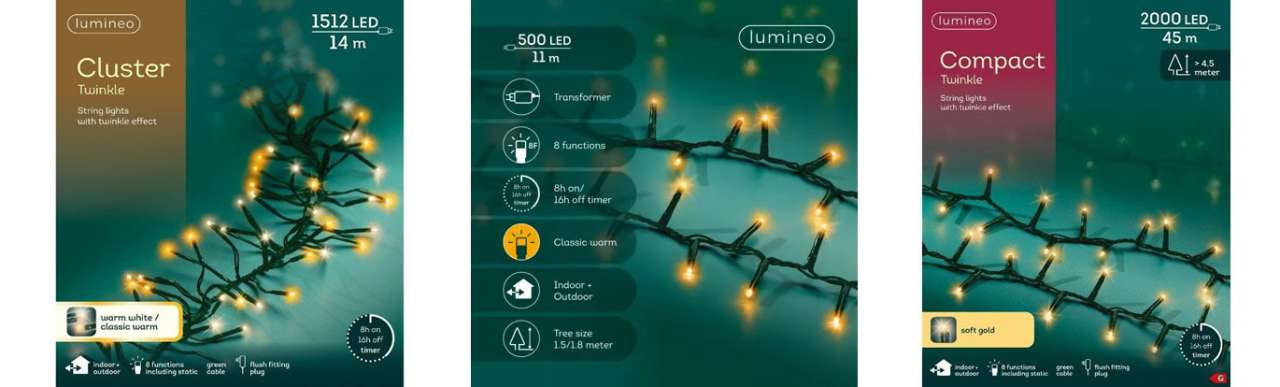
Look out on the packaging for the various characteristics, as you can see here, all three examples are suitable for indoor/outdoor use, they indicate the LED colour, any functions, timers etc. Where a length is shown such as the 14m, 11m and 45m in these examples, this is indicative of the length of lights and is in addition to the lead cable length.
8. A Word About Outdoor Christmas Lighting
Lights around a doorway, on a small garden tree or along a railing can be very welcoming, but outdoor electrical safety matters especially in our damp, windy winters. Use lights specifically rated for outdoor use, secure them against wind, and ensure that plugs, transformers and connections are protected exactly as the manufacturer specifies. Outdoor sockets and suitable circuits should have RCD (Residual Current Device) protection. Never leave electrical connections in puddles or use indoor-only extension leads outside.
Check the route of the cable before buying. Will the lead reach a safe power source? Will the wire cross a path or doorway? Can the lights be put up and taken down without climbing unsafely? A modest, well-placed display is often more attractive—and easier to manage—than lighting every available surface.
9. Christmas Light Safety: A Quick Checklist
- Check cables, plugs, transformers and LEDs for damage before use; do not use a faulty set.
- Follow the product's instructions and keep lights away from candles, heaters and other heat sources.
- Avoid overloading sockets or connecting sets that are not designed to connect together.
- Keep cables out of walkways and away from curious pets and young children.
- Keep electrical components away from the water reservoir of a real Christmas tree.
- Switch off and unplug lights before going to bed or leaving home.
- For outdoor installations, use correctly rated products and properly protected connections.
For further electrical safety guidance, see Electrical Safety First's Christmas lights advice.
Final Thoughts: Choose the Glow You Enjoy
Christmas lights have come a long way since the days of energy-hungry filament bulbs. With modern LEDs, the electricity used by a modest tree-lighting set can be surprisingly low. But the most useful thing is to look beyond the number of bulbs on the box: consider the style, spacing, lit length, wattage, timer and where the set will be used.
Whether you prefer a few warm lights glowing between the branches or a tree that sparkles from top to bottom, the right choice is the one that suits your home and the way you celebrate Christmas.
Find Christmas Lighting Inspiration at Ardcarne
You're welcome to explore the Christmas displays at Ardcarne Garden Centre in Boyle and Roscommon Town, where you can see different lighting effects and compare options. You can also browse our Christmas lights online. We hope this guide helps you choose with confidence, whether you are replacing an old set or making the most of lights you already own.
Share This Guide
Know someone trying to make sense of Christmas lights? Feel free to share this guide.