
Geraniums are among the most useful, reliable and versatile plants you can grow, but they are also one of the plant groups most often misunderstood. Mention “geraniums” and many people immediately picture the colourful summer plants used in pots, window boxes and hanging baskets. These are usually Pelargoniums. True geraniums, often known as hardy geraniums or cranesbills, are a different group altogether — and they are among the finest long-lasting perennials for Irish gardens.
Both pelargoniums and hardy geraniums have their place in the garden. Pelargoniums are wonderful for summer colour in containers, while hardy cranesbill geraniums return year after year, filling borders with flowers, foliage and easy-going reliability. In this guide, we explain the difference between the two before focusing mainly on hardy geraniums — the plants that have earned their reputation as some of the best perennials you can grow.
Pelargoniums vs Hardy Geraniums — What’s the Difference?
The confusion is understandable because pelargoniums are still commonly sold and referred to as geraniums. Botanically, however, they are not the same plant.
| Pelargoniums | Hardy Geraniums / Cranesbills |
|---|---|
| Usually grown as tender summer bedding or container plants | Hardy perennial plants that return year after year |
| Excellent for pots, baskets and window boxes | Excellent for borders, ground cover and naturalistic planting |
| Need frost protection over winter | Hardy in most Irish gardens once established |
| Often grown for bright seasonal colour | Valued for long flowering, reliability and versatility |
| Often propagated from cuttings | Can be divided easily once established |
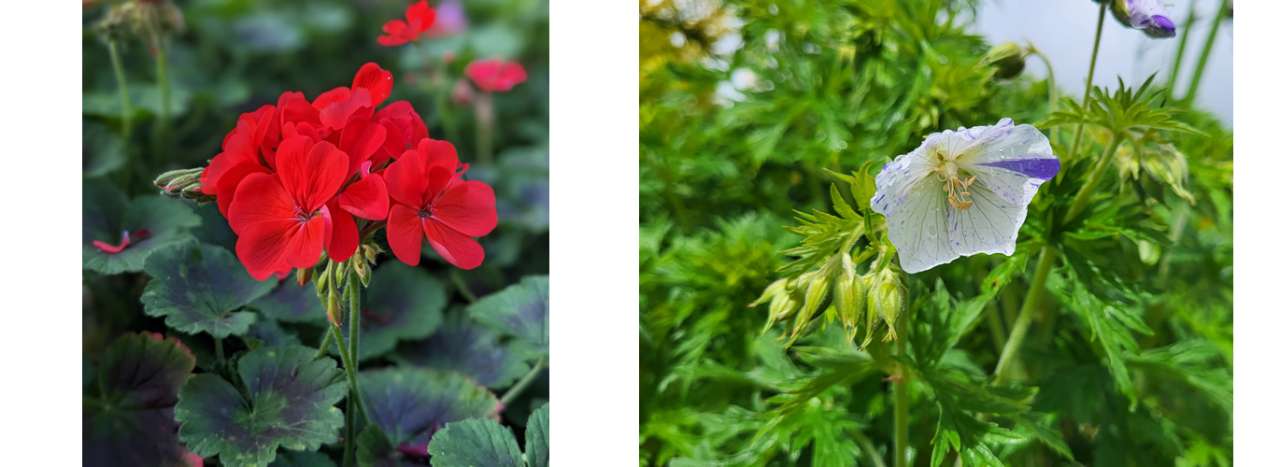
Pelargoniums (left) are fairly tender plants and tend to produce clusters of flowers on stems above scalloped, sometimes bi-coloured or scented foliage. Geraniums (right) are much more hardy, clump forming perennials and generally have finely cut foliage, sometimes with only one flower per stem (Images - Pelargoinium by Cindy from Pixabay and Geranium 'Splish-Splash' by Richard (AGC) taken 04 June 2026)
A Quick Guide to Growing Pelargoniums
Pelargoniums are brilliant for instant summer impact. They thrive in pots, hanging baskets and window boxes, where their bold colours can be enjoyed close to patios, entrances and seating areas.
- Position: Full sun and shelter from strong winds
- Soil: Free-draining compost
- Watering: Water regularly but avoid waterlogging
- Feeding: Feed through the growing season to encourage flowering
- Winter care: Protect from frost by moving into a greenhouse, conservatory or bright indoor space
Pelargoniums can also be propagated from softwood cuttings, usually taken in late summer. This is a useful way to carry favourite plants through from one year to the next.
Why Every Garden Should Have a Hardy Geranium
Hardy geraniums are the real workhorses of the perennial border. They are reliable, adaptable and surprisingly varied, with some forming neat mounds, others spreading as excellent ground cover, and some weaving beautifully through neighbouring plants.
The English gardener Margery Fish famously said:
“When in doubt, plant a geranium.”
It remains excellent advice. Hardy geraniums can solve many planting problems, whether you need long-lasting colour, soil cover, pollinator-friendly flowers or a plant to soften the edges of a border.
Garden Centre Tip:
If you’re looking for a reliable perennial that will tolerate a wide range of conditions, flower for months, attract pollinators and return year after year with very little fuss, it’s hard to beat a hardy geranium. There’s a good reason generations of gardeners have relied on them.
Geraniums as Living Mulch
One of the most useful but often overlooked qualities of hardy geraniums is their ability to act as a living mulch. Many varieties spread gently across the soil surface, helping to cover bare ground between shrubs, roses and taller perennials.
This can bring several benefits:
- Weed suppression: Dense foliage helps reduce space for weed seedlings
- Moisture retention: Covered soil dries out more slowly in warm weather
- Soil protection: Ground-covering plants help protect soil from heavy rain and erosion
- Visual unity: Geraniums can knit planting schemes together beautifully
Varieties such as ‘Rozanne’, ‘Ann Folkard’, ‘Karmina’, ‘Biokovo’ and Geranium macrorrhizum are particularly useful in this role. This also makes them a very useful addition to permaculture designs as both a 'suppressor' and 'attractor' plant as many varieties are also attractive to pollinators.
Where Do Hardy Geraniums Grow Best?
One reason hardy geraniums are so popular is their adaptability. While individual varieties have their preferences, most grow well in ordinary garden soil and are happy in sun or partial shade.
- Sun: Many long-flowering types, including ‘Rozanne’, perform best in sun or light shade
- Partial shade: Many cranesbills thrive in the softer light beneath shrubs or at the edge of borders
- Dry shade: Some types, especially Geranium macrorrhizum, are excellent for difficult dry areas
- Soil: Most prefer reasonably fertile, well-drained soil
In the west of Ireland, hardy geraniums are especially valuable because they cope well with mixed weather and can help create long-lasting colour without needing constant attention.
How to Plant Hardy Geraniums
Hardy geraniums are straightforward to plant and establish quickly when given a good start.
- Plant in spring or autumn when soil conditions are moist but not waterlogged
- Prepare the soil with compost or organic matter
- Plant at the same depth as in the pot
- Water well after planting
- Mulch around plants to conserve moisture and suppress weeds
Most varieties will settle in quickly and begin spreading into attractive clumps over time.
Growing Geraniums in Containers
Although hardy geraniums are most often used in borders, many varieties also grow well in larger containers. This can be particularly useful for patios, entrances or smaller gardens.
- Use a good quality peat-free compost
- Choose a container with drainage holes
- Water regularly during dry spells
- Feed lightly in spring if growth appears weak
Compact varieties such as ‘Frivolius Pink’ and medium-growing types such as ‘Rozanne’ can be especially useful in container displays.
Varieties We Love This Season
Hardy geraniums come in a remarkable range of colours, habits and sizes. Here are some of our favourite varieties currently available this season.
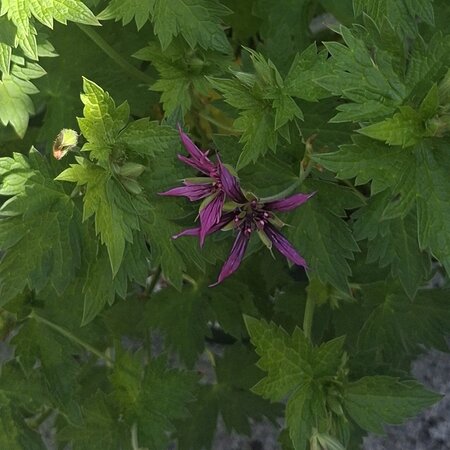
Geranium ‘Catherine Deneuve’
An elegant variety producing masses of soft lavender-pink flowers above attractive mounding foliage.
Its gentle colouring works beautifully in cottage garden planting schemes and mixed perennial borders where it combines particularly well with salvias, roses and ornamental grasses.
Best for: Mixed borders, cottage gardens and pollinator-friendly planting.
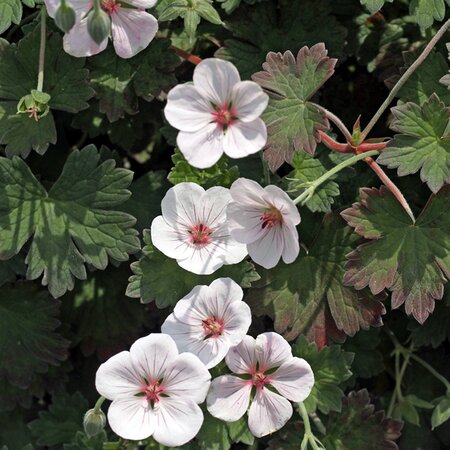
Geranium ‘Coombland White’
A beautiful white-flowered cranesbill that brings brightness and contrast to perennial borders.
The pure white blooms help lift darker planting combinations and are especially effective when paired with purple, blue or burgundy-flowered companions.
Best for: Shadier borders, rose gardens and white planting schemes.
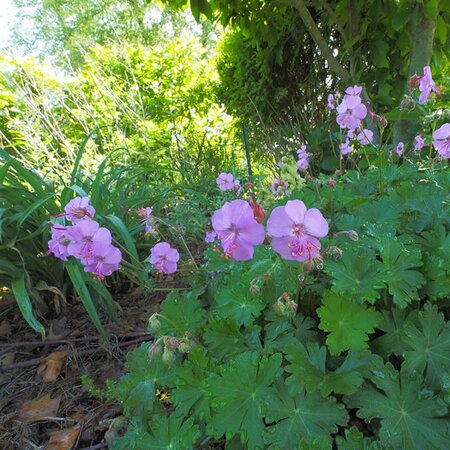
Geranium ‘Karmina’
One of the finest spreading geraniums available, producing vibrant pink flowers over a long season.
Its low-growing habit makes it particularly useful as ground cover where it can suppress weeds while softening the edges of paths, borders and raised beds.
Best for: Ground cover, banks, slopes and informal borders.
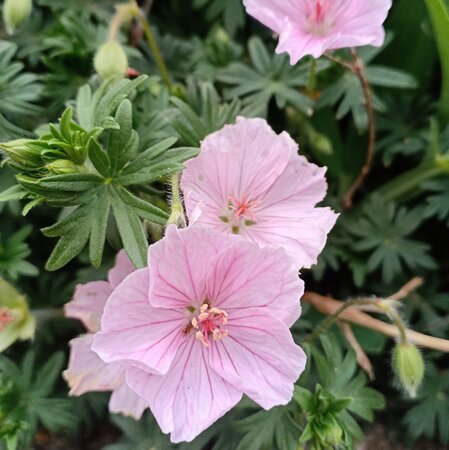
Geranium ‘Frivolius Pink’
A compact, free-flowering variety producing soft pink blooms throughout much of the growing season.
Its tidy habit makes it particularly suitable for smaller gardens, front-of-border planting and larger patio containers.
Best for: Smaller gardens, containers and long-lasting colour.
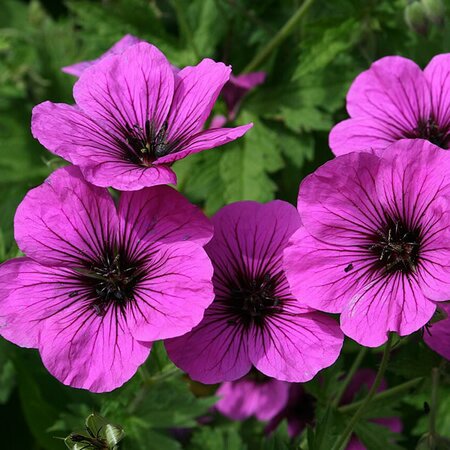
Geranium psilostemon
One of the most dramatic hardy geraniums available, producing large magenta flowers with distinctive dark centres.
Taller than many other varieties, it adds height, structure and bold colour to herbaceous borders and cottage garden schemes.
Best for: Larger borders, cottage gardens and dramatic summer displays.
Honourable Mentions — Classic Hardy Geraniums
Alongside newer or more unusual varieties, there are several hardy geraniums that have become garden classics for good reason.
- Geranium ‘Rozanne’: Perhaps the most famous modern hardy geranium, producing violet-blue flowers over an exceptionally long season from early summer into autumn.
- Geranium ‘Ann Folkard’: A beautiful trailing variety with magenta flowers and golden-green young foliage, excellent for weaving through neighbouring plants.
- Geranium ‘Johnson’s Blue’: A classic blue-flowered variety that remains popular in cottage garden borders.
- Geranium ‘Biokovo’: A reliable semi-evergreen ground-cover variety with soft pink-white flowers and attractive aromatic foliage.
- Geranium macrorrhizum: One of the best choices for dry shade, with fragrant foliage, good weed suppression and reliable flowers.
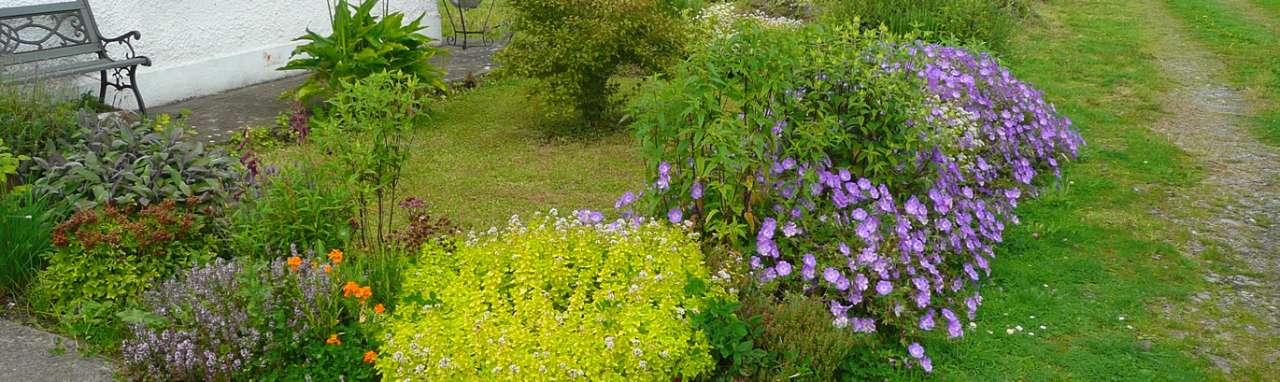
Geranium 'Rozanne' gets mentioned a lot in articles and on gardening programmes and it's easy to see why. I have them planted around other perennials, shrubs and herbs in my front garden and they are great for filling gaps with colour that is provided over a long flowering season. I took this photo back in 2022 and they are still going strong (well, stronger) today, with the clumps of foliage nicely formed outside and just beginning to flower at the time of putting this article together (04/06/2026) - Richard.
Companion Planting with Hardy Geraniums
Hardy geraniums are excellent companion plants because they combine easily with so many other garden favourites. Their soft foliage and informal flowers help connect planting schemes and fill gaps without overwhelming neighbouring plants.
Good companions include:
- Roses: Geraniums soften the base of rose bushes and help cover bare soil beneath them.
- Salvia: Upright flower spikes contrast beautifully with the rounded habit of geraniums.
- Nepeta: Shares a relaxed, informal style and attracts plenty of pollinators.
- Alchemilla mollis: Soft lime-green flowers combine beautifully with pink, blue and purple geraniums.
- Astrantia: Works well in partial shade and adds delicate structure.
- Ornamental grasses: Add movement and texture alongside low-growing or spreading geraniums.
Because many hardy geraniums also help cover soil, they can be especially useful around shrubs, roses and taller perennials where they reduce bare gaps and suppress weeds.
Propagation and Division
Hardy geraniums are easy to propagate, particularly by division. This is a useful way to increase your stock, refresh older clumps or move plants to new areas of the garden.
When to Divide
The best times to divide hardy geraniums are:
- Spring, as new growth begins
- Early autumn, while soil is still warm and moist
How to Divide
- Lift the clump carefully with a fork
- Separate into smaller sections, each with healthy roots and shoots
- Replant immediately into prepared soil
- Water well and keep moist while plants re-establish
Division can also help rejuvenate older clumps that have become congested or less vigorous.
Geraniums for Difficult Areas
One of the great strengths of hardy geraniums is their ability to solve common planting problems. Whether you need ground cover, long-season flowers or a plant for shade, there is usually a geranium worth considering.
| Garden Situation | Suggested Geranium |
|---|---|
| Dry shade | Geranium macrorrhizum |
| Full sun and long flowering | ‘Rozanne’ |
| Ground cover | ‘Karmina’, ‘Biokovo’ |
| Cottage garden borders | Geranium psilostemon, ‘Johnson’s Blue’ |
| Containers and smaller spaces | ‘Frivolius Pink’, ‘Catherine Deneuve’ |
| Softening rose borders | ‘Coombland White’, ‘Rozanne’, ‘Biokovo’ |
Common Problems
Hardy geraniums are generally trouble-free, but a few issues can occur from time to time.
- Slug damage: Young spring growth can occasionally be damaged, especially in damp conditions. Check around new shoots and use suitable controls if needed.
- Powdery mildew: Can appear during dry or stressful conditions. Watering at the base and improving airflow can help.
- Overcrowded clumps: Older plants may become less vigorous and benefit from division.
- Plants disappearing in winter: Many hardy geraniums are herbaceous and naturally die back before re-emerging in spring.
If a hardy geranium appears to have vanished over winter, don’t be too quick to assume it has died. Many varieties return from below ground once temperatures rise.
Final Thoughts
Hardy geraniums are among the most useful and dependable perennials for Irish gardens. They offer colour, foliage, ground cover, pollinator value and long-term reliability with very little fuss.
While pelargoniums provide wonderful seasonal displays in pots and baskets, true hardy geraniums are the plants that quietly earn their keep year after year in the garden. Whether you are filling gaps, softening borders, planting beneath roses or looking for a reliable perennial that simply gets on with the job, Margery Fish’s advice still rings true: when in doubt, plant a geranium.
Looking for the perfect geranium for your garden?
Visit our garden centres in Boyle and Roscommon to explore our latest range of hardy geraniums and pelargoniums, or speak to our team for advice on choosing the right variety for your garden.