
Why Compost?
Compost is one of the simplest ways to improve your soil, recycle garden and kitchen waste and return organic matter to the garden. But compost isn't simply something we add because "plants need feeding". Its benefits go much further than that.
Healthy soil is a living environment containing minerals, organic matter, air, water and countless organisms. Adding compost helps maintain that environment, improving the structure of the soil while gradually returning nutrients and organic matter that plants have used. Compost adds organic matter, helps improve soil structure, supports soil organisms and can help sandy soils retain moisture while making heavy soils easier to work.
The nutrients it contains are then gradually made available to plants as the organic matter breaks down.
It also has a financial benefit in that it may save you a lot of weight going into those brown compost bins that get collected if you happen to have one.
Why Does This Matter in the Vegetable Garden?
Think of growing vegetables as a simple equation.
Soil → Plant → Harvest → Kitchen
Plants take minerals and nutrients from the soil to produce their leaves, roots, fruits and seeds. When we harvest those vegetables and eat them, some of those nutrients leave the garden with the food.
We can return the remaining plant material to the compost heap, but we can't compost the potatoes we've eaten or the carrots that ended up on the dinner table!
So even if you compost almost everything that remains in the garden, there can still be a gradual loss of nutrients from the system. Adding compost, manure or other organic matter helps replace some of what has been removed and keeps the soil productive.
This is one reason why regularly adding organic matter is such an important part of maintaining a productive vegetable garden.
Compost and Ornamental Plants
The same principles apply to flower borders, shrubs and trees. Plants take nutrients from the soil as they grow, while organic matter gradually breaks down and is lost over time.
Adding compost as a soil improver or mulch can help maintain a healthy growing environment, while also improving moisture retention and soil structure.
For established borders, a layer of compost or well-rotted organic matter applied around plants can be a simple way of maintaining the soil without repeatedly disturbing plant roots.
Why Use Compost Instead of Just Garden Soil in Containers?
It might seem logical to dig up some of your own garden soil and put it into a pot. Unfortunately, garden soil isn't generally well suited to container growing on its own.
Once confined in a container, soil can become compacted, drain poorly and restrict the development of plant roots. A good-quality growing compost is formulated to provide the balance of drainage, moisture retention, air and nutrients that container-grown plants need.
This is particularly important because a container is essentially an artificial growing environment. Unlike plants growing directly in the ground, roots cannot simply continue into the surrounding soil when conditions become difficult.
Making Your Own Compost
You don't need a perfectly engineered composting system to make useful compost. A compost heap can be exactly that – a heap in a suitable corner of the garden.
Alternatively, you can use a purpose-built compost bin, or, if you have the space, create a larger multi-bay system that allows you to have compost at different stages of decomposition.
There are many different approaches to composting, so don't feel that you need to create the perfect system before you begin.
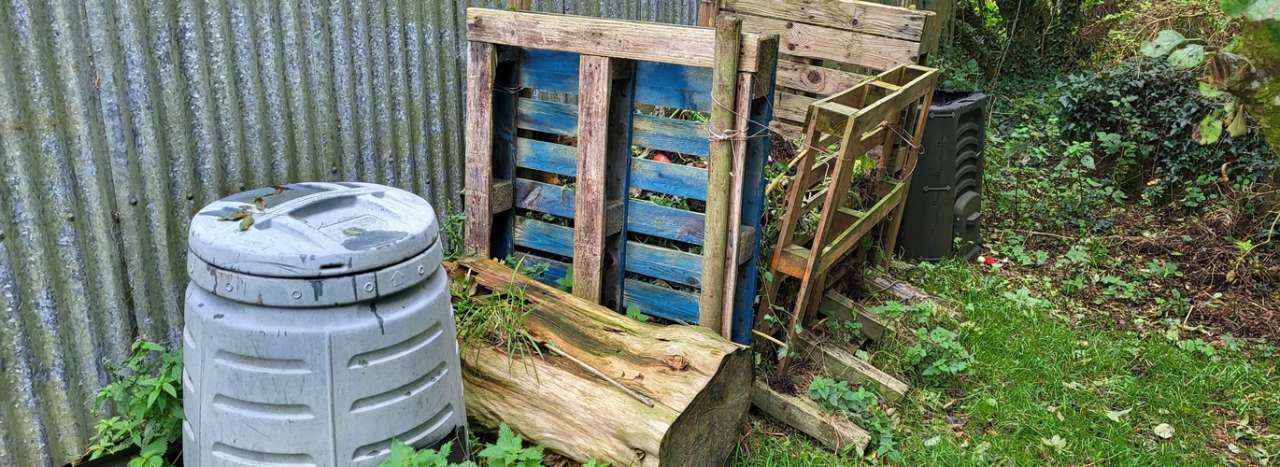
This is my makeshift 3 bay compost 'system' where I just cobbled together a main 'bay' with a few pallets and I use a couple of old compost bins that I've bought over the years to make up the other 2 bays to 'turn' my compost into as it degrades. Photo by Richard (AGC) taken 24/09/2026.
Home-made compost doesn't have to look like the perfectly uniform compost you buy in a bag. Rougher, partially decomposed material still has plenty of uses in the garden. Plants such as squash are quite happy growing into less-finished compost, while coarser material can also make an excellent mulch around established plants. You can also filter your compost using a garden sieve so that you have multiple grades of compost - you can use the finely sieved compost for seeds, containers and top-dressing, whilst the rougher material left behind can either be left to degrade further or dug into your soil to provide slower release nutrients.
Green and Brown Materials
A healthy compost heap needs a mixture of different materials. A useful rule of thumb is to aim for roughly two to three parts brown material to one part green material, although you don't need to measure everything precisely.
| Green Materials | Brown Materials |
|---|---|
| Grass clippings | Dry leaves |
| Fresh weeds | Shredded cardboard |
| Vegetable peelings | Paper and uncoated cardboard |
| Spent vegetable plants | Small woody prunings |
| Fresh plant material | Straw and dried plant material |
| Coffee grounds | Egg boxes and cardboard packaging |
Green materials are generally richer in nitrogen and tend to be fresh and moist, while brown materials provide carbon and help keep the heap open enough for air to circulate.
The important thing is variety. A heap made almost entirely from grass clippings is likely to become wet and compacted, while a heap containing mostly dry leaves and woody material will break down much more slowly.
What Shouldn't Go on the Heap?
It's best to keep some materials out of a conventional home compost heap.
- Cooked food, meat and fish
- Dairy products
- Pet waste
- Diseased plant material
- Large quantities of perennial weeds carrying roots or seed heads
- Glossy or heavily printed paper
- Plants treated with persistent herbicides where you are unsure whether residues may remain
Some composting systems are specifically designed to process materials such as cooked food and meat, but a simple garden compost heap is generally better kept to plant-based material.
Keeping Vermin Away
A well-managed compost heap shouldn't become an open invitation to rats or other unwanted visitors. Most problems arise when food waste is exposed or the heap becomes too wet.
- Keep cooked food, meat and fish out of a conventional garden compost heap.
- Cover fresh kitchen scraps with a layer of brown material.
- Don't leave vegetable peelings exposed on the surface.
- Keep the heap reasonably well balanced rather than allowing it to become waterlogged.
- If using a compost bin, make sure it is secure and sits firmly on the ground.
A compost heap doesn't need to smell bad. A healthy heap should have an earthy smell rather than an unpleasant one. Strong odours often indicate that the material is too wet, compacted or lacking sufficient brown material and air.
Do You Need to Turn Your Compost?
Turning introduces air and mixes the materials, which can help the heap break down more quickly. However, it isn't essential for making useful compost.
If you have a simple heap and aren't in a hurry, you can allow nature to do much of the work. Larger multi-bay systems make it easier to move material through different stages of decomposition and can produce compost more efficiently.
There are also several different approaches to managing a multi-bay system, so we've kept this guide deliberately simple. For a more detailed demonstration, see our recommended Charles Dowding composting video, which shows how a three-bay system can be managed with relatively little turning.
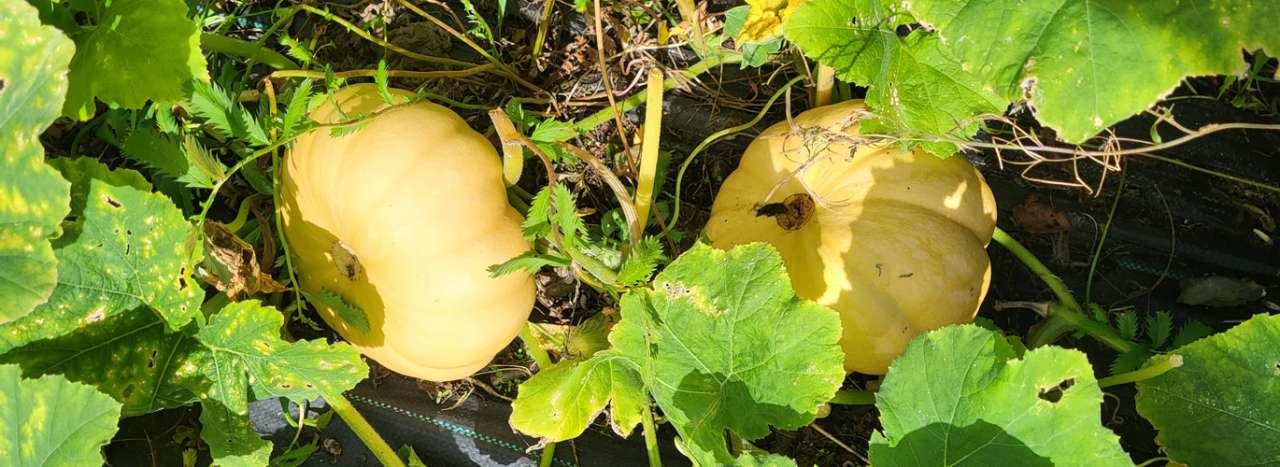
This squash was grown very successfully growing on a heap of partially decomposed material that I covered with Mypex/weed matting. I then cut holes in the weed-matting, in which I inserted my plants back in May. The plants have produced a good yield of lovely squash, proving you don't have to have 'shop grade' compost to plant into for everything. This particular variety of squash is 'Autumn Crown' a cross between 'Crown Prince' and a butternut squash, which I'd highly recommend. Photo taken by Richard (AGC) on 24/09/2026.
Compost or Fertiliser?
Compost and fertiliser aren't necessarily competing products – they perform different roles.
Fertilisers can provide specific nutrients in a form that plants can access relatively quickly, which can be useful when a particular nutrient is lacking or when a plant has specific feeding requirements.
Compost, manure and other organic matter work more gradually. They contribute organic matter to the soil, improve its structure and support the organisms that help nutrients become available to plants.
For long-term soil health, regularly adding organic matter is therefore an important part of a sustainable gardening approach. It doesn't mean fertilisers are never useful, but relying on fertiliser alone doesn't replace the physical and biological benefits of adding organic matter.
Remember
- Compost isn't just plant food – it helps maintain the soil in which plants grow.
- Growing and harvesting vegetables removes nutrients from the garden, so some of those nutrients need to be replaced.
- A mixture of green and brown materials produces a healthier compost heap.
- Home-made compost doesn't have to be perfectly crumbly to be useful.
- Cover fresh kitchen waste with brown material to help deter vermin.
- You don't need a perfect composting system to get started – even a simple heap can produce useful organic matter.
Feed the Soil, and the Soil Feeds the Plants
Good composting is ultimately about looking after the soil rather than simply feeding individual plants. By returning organic matter to the garden, we help maintain the structure, moisture-holding capacity and biological activity that plants depend upon.
Whether you have a simple heap, a compost bin or a multi-bay system, making your own compost is one of the easiest ways to turn some of your garden and kitchen waste into something genuinely useful.
And remember, it doesn't have to look perfect to do a good job.
Give Your Garden a Healthy Start
From compost and soil improvers to seeds, plants and growing supplies, we have everything you need to build healthy soil and get the most from your garden.