
An artificial Christmas tree can become part of your family’s festive traditions for many years. The right one should suit your room, your decorating style and the amount of time you want to spend setting it up each December. With so many heights, shapes, finishes and lighting options available, a little planning makes choosing much easier.
At Ardcarne Garden Centres in Boyle and Roscommon Town, our Christmas showrooms bring together a selection of artificial trees to help you find the right fit for your home. This guide walks through the main things to consider before you buy, along with a few practical tips to make setting up and storing your tree easier.
1. Choose the right height
Start by measuring the floor-to-ceiling height of the room where your tree will stand. Remember to allow room for the stand and for a topper, such as a star or angel. You will also want a little breathing space between the top of the finished tree and the ceiling.
- For a standard-height room: a tree around 6–7ft may be a comfortable choice, depending on your ceiling height and topper.
- For rooms with high ceilings: a taller tree can make a wonderful focal point, provided there is enough clearance and room to decorate it safely.
- For smaller rooms, bedrooms or hallways: a 4–6ft tree may give you the festive feel you want without overwhelming the space.
- For a tabletop display: a small tree can work beautifully on a sturdy sideboard or table, provided it is stable and away from heat sources.
As a useful starting point, allow roughly 30–45cm between the ceiling and the top of the tree, including its topper. Check the tree’s stated assembled height and stand dimensions before purchasing, as measurements and proportions vary between models.
2. Check the width and profile
Height is only half the story. A full, wide tree can be spectacular in an open room, but it may block a walkway or take up more floor space than expected. Check the maximum diameter or width stated for the tree, and measure the area where the branches will spread.
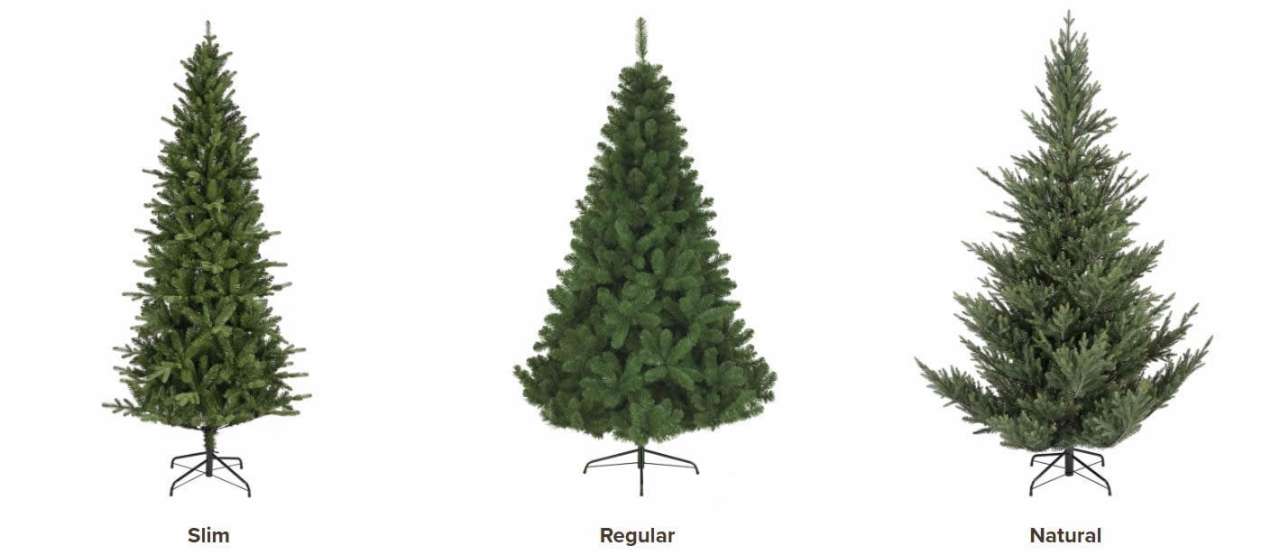
- Regular or full shape: a classic, generous silhouette that suits larger living rooms and spaces where the tree can be a main feature.
- Slim or pencil shape: a narrower profile for corners, bay windows, smaller rooms or areas where floor space is limited.
- Natural or more open shape: an intentionally less uniform silhouette that can look more like a tree growing outdoors, with space between some branches for ornaments to show.
- Compact or half-tree designs: where available, these can be useful when space is very limited, though it is worth checking how the back is finished and where the tree is intended to sit.
Do not forget to account for nearby furniture, doors, curtains and the route people use through the room. If the tree will sit in a corner, consider how much of its shape will actually be visible.
3. Understand the difference between PE and PVC needles
The materials used for the branches have a big influence on how realistic a tree looks and feels. You may see the terms PE and PVC on product descriptions.
- PE (polyethylene) tips: these are moulded to give the needles and branch shapes more depth and texture. They are often used on the visible outer parts of higher-realism trees because they can resemble real evergreen foliage more closely.
- PVC (polyvinyl chloride) needles: these are usually made from flat strips of material. They help create fullness and can offer a traditional artificial-tree look at a more accessible price.
- Mixed PE and PVC foliage: many trees combine the two. Moulded PE tips can provide realism on the outside, while PVC foliage adds density further in towards the trunk.
With our Everlands Trees you may see the trees listed as 'Soft Needle', 'Real Needle or Hard Needle':
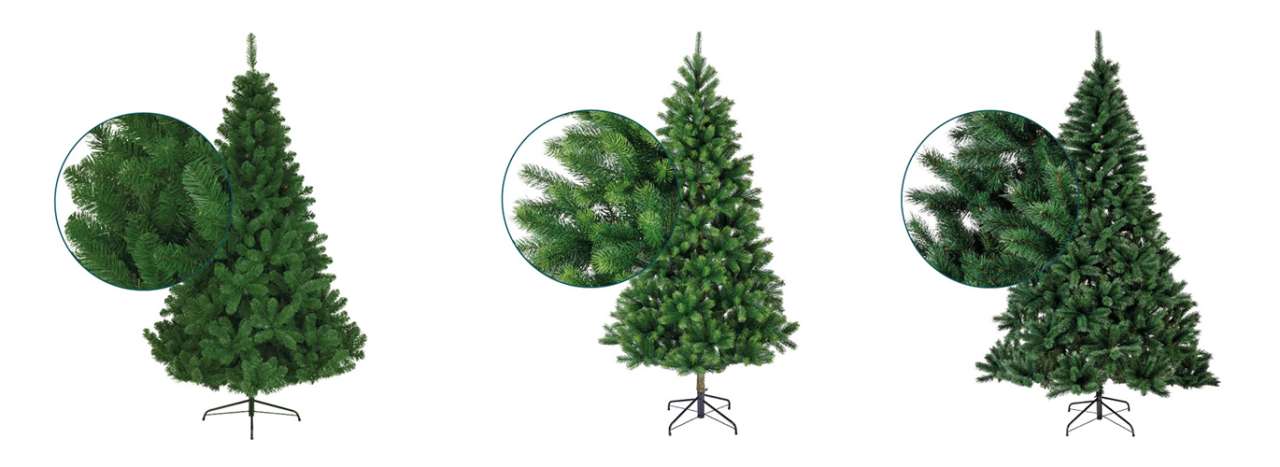
From Left to Right: Soft, Real and Hard Needle Christmas Trees
- Soft Needle - Made of PVC, these needles have a soft texture.
- Real Needle - Made from PE, they have a very natural appearance and matches the thickness and solidity of real branches. The shape and look produce a very realistic looking artificial Christmas tree.
- Had Needle - These needles, which are slightly harder to the touch, are made from thicker and longer PVC to produce a brushier needle; as a result, the tree feels harder.
There is no single material that is right for everyone. If realism is your priority, look closely at the outer tips and branch structure. If you mainly want a tree that looks full once decorated and offers good value, a well-made PVC or mixed-foliage tree may suit you perfectly.
4. Pre-lit or unlit: which suits you?
A pre-lit tree has lights fitted as part of its design, while an unlit tree gives you a blank canvas for your own lighting scheme. Both have advantages, and the best choice depends on how you like to decorate.
Pre-lit trees
- Convenient to set up, with lights already positioned through the branches.
- Can give a consistent spread of light without having to wrap separate strings around the tree.
- Some models offer different light colours or lighting effects; check the individual product specification.
- Before buying, check how the light sections connect, whether replacement parts or bulbs are available, and what the product warranty covers.
Unlit trees
- Give you complete freedom to change the lights and decorating theme from year to year.
- Allow you to choose the colour, brightness, style and spacing of your lights.
- Can be a good option if you already own a favourite set of lights.
- Require a little more time to decorate, and you will need to store the lights separately.
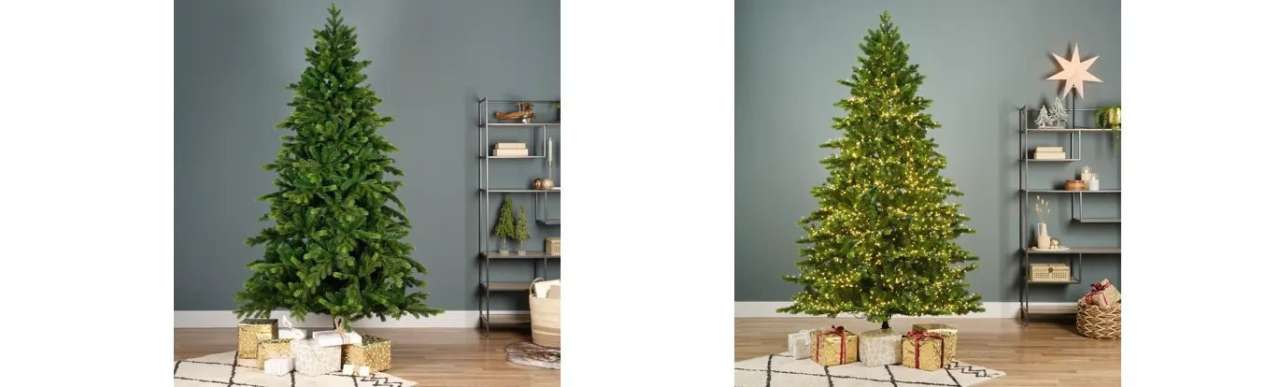
Above we see an unlit Galloway Tree against a pre-lit Galloway Tree
5. Pick a colour and finish
Green is a timeless choice, but artificial trees now come in a range of colours and finishes. Think about the decorations you already own and the atmosphere you want to create.
- Classic green: versatile and easy to decorate with traditional reds and golds, natural textures, woodland ornaments or a simple white-light scheme.
- Frosted or flocked: designed to give the impression of snow on the branches. These can create a wintery look with silver, champagne, white or soft-coloured decorations. Flocking may shed a little during handling and set-up, depending on the tree.
- Snowy or heavily frosted finishes: make a strong statement on their own, so you may prefer a lighter touch with ornaments.
- White or other statement colours: offer a more contemporary look and can work well with coordinated decorations and lighting.
If you are unsure, choose a finish that will work with decorations you already have. You can always change the look with ribbons, baubles, natural materials and lights rather than replacing the tree itself.
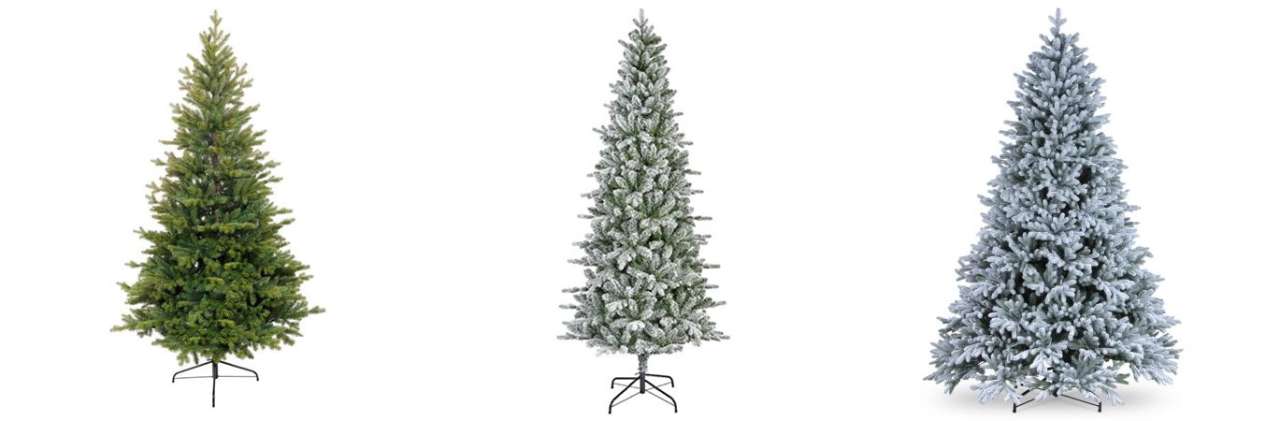
From Left to Right: Green Allison Pine, Frosted Killington Fir and a Snowy Hamilton Tree
6. Branch construction and set-up
Most artificial trees are made in sections that fit together around a central pole. Many use hinged branches that drop down into position when the tree is assembled; other designs may require branches to be attached individually. Check the product details so you know what to expect.
Allow time to shape the branches before decorating. Trees are packed tightly for transport and storage, so they generally look much fuller once each branch and tip has been spread out carefully.
How to shape your tree
- Assemble the stand and tree sections according to the instructions, ensuring the tree is stable before you begin.
- Work from the bottom section upwards. If the branches are hinged, lower them into position before shaping each one.
- Start near the trunk and work outwards, separating the smaller tips so the centre is less visible.
- Vary the direction of the tips rather than arranging every one in a flat line. This helps create a more natural, full appearance.
- Step back occasionally and look at the tree from the angles where it will be seen in your home. Make small adjustments before adding decorations.
Gloves can be useful when shaping some trees, particularly those with flocked finishes. Follow the manufacturer’s instructions and take care around metal hinges and branch ends.
7. Think about storage before you buy
Your tree will spend much of the year packed away, so it is worth considering where it will live between Christmases. A taller or fuller tree may need more storage space than you expect, even when separated into sections.
- Check the packed dimensions if these are provided, especially if you need to store the tree in an attic, cupboard or shed.
- Keep the original box or use a suitable tree-storage bag to protect the branches from dust and damage.
- Before packing it away, remove decorations and follow the manufacturer’s instructions for dismantling and storing any lights.
- Store the tree somewhere dry and avoid crushing the branches under heavy items.
- If you choose a flocked tree, handle it gently and expect that some decorative snow may loosen over time.
8. Choose a tree that suits your budget
Artificial trees vary in price according to their height, fullness, materials, finish, lighting and construction. A higher price may reflect more realistic moulded tips, a more elaborate branch structure or integrated lighting, but price alone does not tell you whether a tree is right for your home.
Think about the features you will notice most. If the tree is the main feature of your sitting room and you want a realistic appearance, you may decide that PE or mixed-foliage branches are worth considering. If you enjoy changing your decorations every year, an unlit tree may offer more flexibility. If quick set-up is a priority, a pre-lit model could be a better fit.
Rather than choosing on price alone, compare the tree’s height, width, materials, lighting, stand, storage requirements and warranty. A tree that suits your space and how you celebrate is likely to give you more satisfaction over time.
9. A few practical checks before you decide
Before making your final choice, run through this quick checklist:
- Have I measured both the ceiling height and the available floor space?
- Have I allowed for a topper, the stand and the full spread of the branches?
- Will the tree leave doors, walkways and nearby furniture accessible?
- Do I prefer a full, slim or more natural-looking profile?
- Would I rather have a pre-lit tree or choose my own lights?
- Does the colour and finish suit the decorations I already own?
- Do I have somewhere suitable to store it after Christmas?
- Have I checked the product instructions, light specifications and warranty details?
10. Choosing an Artificial Christmas Tree for a Pet-Friendly Home
For many of us, Christmas wouldn't be Christmas without our four-legged family members. But while a beautifully decorated tree is a festive centrepiece for the home, it can also be a source of fascination for curious cats and playful dogs!
The good news is that a little planning can help you enjoy your Christmas tree while making your home safer for your pets. Although no artificial tree is completely pet-proof, your choice of tree and where you position it can make a real difference.
Consider the shape and stability
If you have an energetic dog, a young puppy or a cat who loves to climb, stability should be high on your list of priorities.
- Choose a sturdy stand: Check that the stand is suitable for the size and weight of the tree, and assemble it according to the manufacturer's instructions.
- Think about the profile: A slim tree may be easier to accommodate in a smaller room or tucked into a suitable corner, reducing the space available for pets to run around it. However, a slim tree is not necessarily more stable, so check its base and overall construction.
- Consider the branches: Dense foliage can make it harder for pets to reach ornaments near the trunk, although no branch style will prevent a determined cat from investigating!
- Position it thoughtfully: A quiet corner away from busy walkways, favourite jumping points and furniture that gives cats easy access to the branches may help reduce temptation.
If your pet is particularly boisterous, consider securing the tree to a suitable fixed point where practical, using an appropriate method that will not damage the tree or create another hazard.
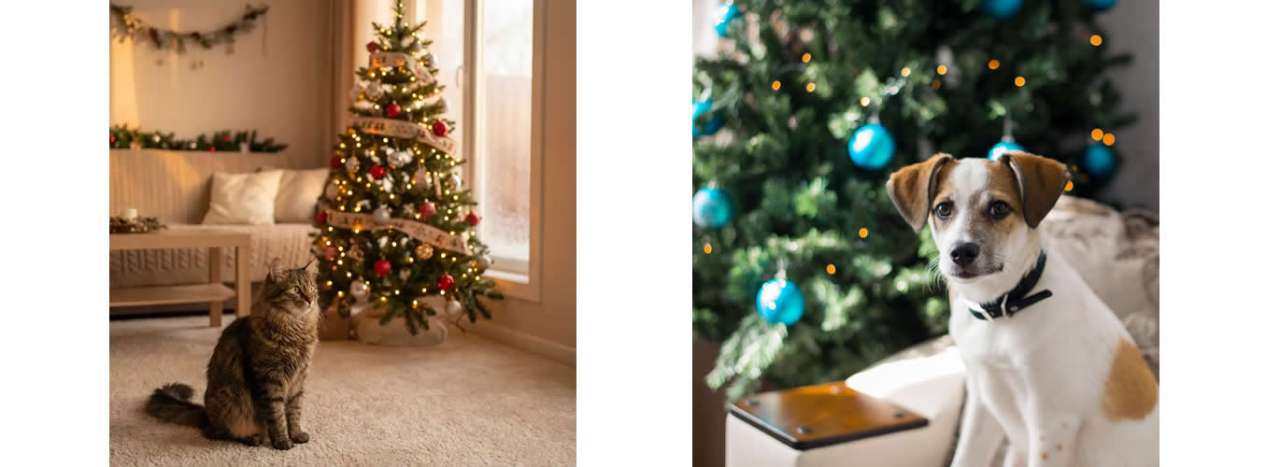
Be careful with decorations and lights
For many pets, the most tempting part of the Christmas tree is not the tree itself, but everything hanging from it!
- Choose shatter-resistant decorations: Plastic, wood or fabric ornaments are generally a more practical choice than glass baubles that can break into sharp pieces.
- Keep tempting decorations higher up: Place delicate, valuable or particularly attractive decorations towards the top of the tree, while keeping the lower branches simpler. Remember that cats can reach much higher than dogs!
- Avoid edible-looking decorations: Chocolate decorations, edible treats and anything containing ingredients that are unsafe for pets should be kept well out of reach.
- Secure lights and cables: Keep electrical leads tidy and inaccessible where possible, as chewing cables can cause serious injury. Switch off lights when you are not at home or are asleep.
- Skip hazardous hanging items: Tinsel, loose ribbons, hooks and small decorations can cause problems if swallowed. Cats, in particular, may be attracted to string-like materials, which can cause serious intestinal injuries if ingested.
What about artificial tree needles?
Artificial trees avoid the regular needle drop associated with many real Christmas trees, but they are not entirely without risk. Some pets may chew or swallow plastic foliage, particularly if they are young, curious or prone to chewing.
Choose a tree with securely attached branches and tips, check it periodically for loose pieces, and discourage pets from chewing the foliage. If you know your dog or cat is likely to eat parts of the tree, supervise access carefully and consider using a barrier to keep them away.
Artificial trees should not be considered safe to chew or eat. If you suspect your pet has swallowed needles, decorations, tinsel or another foreign object, contact your vet for advice rather than waiting for symptoms to appear.
Give curious pets time to adjust
A Christmas tree can be an exciting new arrival, particularly for pets who have never encountered one before. Allow them to investigate under supervision, reward calm behaviour and redirect unwanted climbing or chewing rather than relying on the tree itself to withstand their attention.
For cats who love climbing, placing the tree away from shelves, window ledges and furniture that could act as launching points may help. For dogs, keeping the tree out of a favourite play area and maintaining a clear route through the room can reduce the chance of accidental knocks.
Our tip: If you have a particularly adventurous pet, start with simple, sturdy decorations and add more once you know how they react. Sometimes the best approach is to create a festive display that works for the whole household, rather than trying to recreate a picture-perfect tree that your pets have other ideas about!
With a stable tree, sensible decoration choices and a little supervision, you can enjoy a festive home that is welcoming to both two-legged and four-legged family members.
11. Safety and setting up at home
Artificial trees still need to be set up thoughtfully, especially when lights and decorations are involved.
- Place the tree on a stable, level surface and secure it in its stand as instructed.
- Keep the tree and its cables away from fireplaces, heaters, candles and other sources of heat or flame.
- Use lights suitable for the tree and follow the manufacturers’ instructions. Check cables and plugs for damage before use.
- Avoid overloading sockets or connecting more light sets together than the manufacturer permits.
- Keep cables tidy and out of walkways, and consider the placement of the tree if young children or pets are likely to pull at branches or decorations.
- Switch off tree lights when going to bed or leaving home, unless the product instructions specifically state otherwise.
Artificial trees are not automatically fireproof. Check the labelling and instructions for your particular tree, and always take care with electrical decorations.
Conclusion: find the right tree for your home
The perfect artificial Christmas tree is not necessarily the tallest, fullest or most expensive. It is the one that fits your room, suits your style and makes decorating for Christmas a pleasure. Measure first, compare the profile and materials, decide whether pre-lit convenience appeals to you, and remember to plan for storage as well as set-up.
If you can, seeing trees in person is a great way to compare their shape, texture and finish. Bring your measurements along and our team can help you explore the options available.
Ready to find your Christmas tree?
Visit the Christmas showrooms at Ardcarne Garden Centres in Boyle and Roscommon Town to explore our festive tree selection and find a style that feels just right for your home.
Find your nearest Ardcarne Garden Centre Browse Christmas trees online